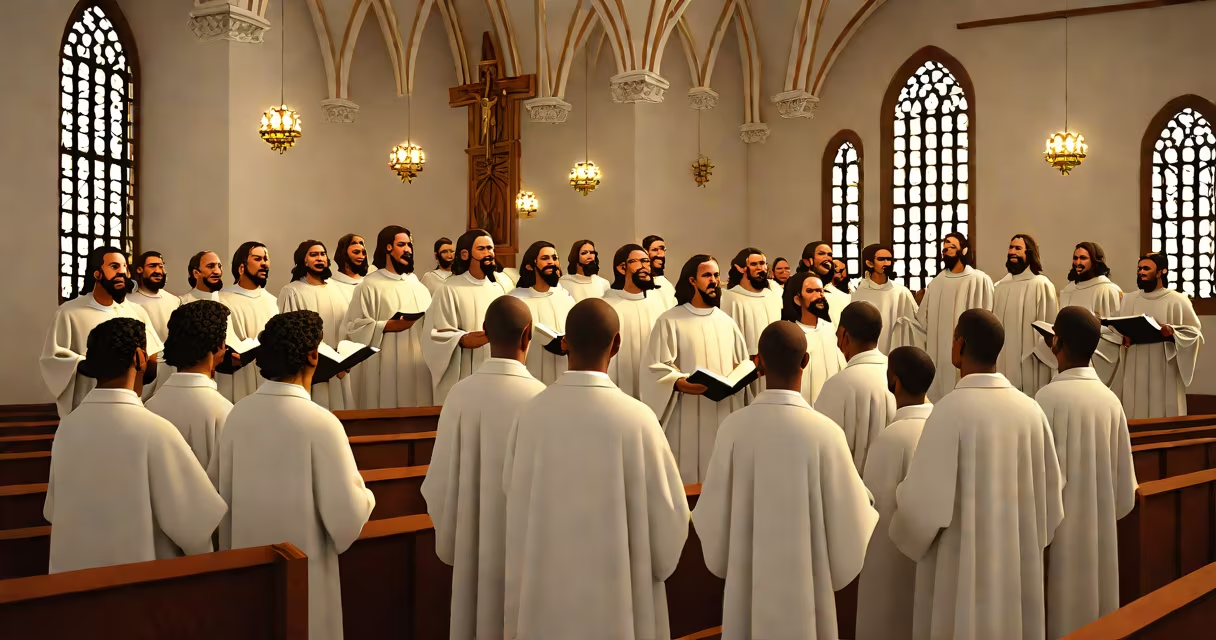
"Vencendo vem Jesus" is a Portuguese Christian hymn that proclaims Jesus' triumph over evil, sin, and death. The phrase translates literally to "Victorious, Jesus comes," emphasizing His power and divine authority in Christian belief.
The hymn originates from the Latin liturgical tradition and was adapted into Portuguese in the late 20th century. It is often sung during worship services, especially in Pentecostal, charismatic, and evangelical churches across Brazil, Portugal, and other Portuguese-speaking regions. Its lyrical structure follows a call-and-response pattern common in gospel music, making it easy to learn and sing in congregations.
Lyrics typically begin with a declaration of victory: "Vencendo vem Jesus, com poder e glória" ("Victorious, Jesus comes, with power and glory"). The refrain repeats the central theme: Jesus conquers through love, sacrifice, and resurrection. The melody is upbeat, with a driving rhythm that encourages communal participation.
In practice, "vencendo vem Jesus" functions as a declaration of faith. Singing it aloud reinforces doctrinal beliefs about Christ's divinity and redemptive power. It is frequently used during moments of celebration-such as Easter, Pentecost, or church anniversaries-and as a closing anthem to inspire confidence in believers.
Many churches use live instruments such as piano, drums, and electric guitar to accompany the song, blending traditional hymnody with contemporary worship styles. Some versions include a spoken-word intro or a solo verse before the chorus, adding dramatic tension before the full congregation sings the refrain.
For example, during a Palm Sunday service in Rio de Janeiro, a congregation of over 1,200 people sang "Vencendo vem Jesus" as they processed through the church courtyard, waving palm branches. The energy rose with each repetition of the chorus, creating a unified expression of hope and joy.
The hymn generally follows a four-part structure:
| Section | Content | Function |
|---|---|---|
| Verse 1 | "Vencendo vem Jesus, com poder e glória" | Introduces the theme of Christ's victory |
| Chorus | "Rei da glória, venceu o mal!" | Reinforces the central message: Jesus defeated evil |
| Verse 2 | "Com seu nome, o inferno se quebra" | Asserts Jesus' authority over darkness and demonic forces |
| Outro | "Aleluia! Aleluia!" (repeated) | Builds momentum toward worshipful climax |
Minor variations exist across regions. In Angola, some congregations replace "inferno" with "morte" ("death") to emphasize resurrection. In São Paulo, a popular version includes a spoken bridge: "Ele não morreu por nada - Ele venceu por todos."
A lesser-known fact: the original melody was adapted from a 19th-century German Lutheran tune, "Christus ist erstanden," which itself draws from early Christian chant traditions. This lineage shows how global Christian music shares roots across languages and centuries.
Some assume "vencendo vem Jesus" is a modern pop song due to its rhythmic delivery. But it is rooted in liturgical tradition, not secular entertainment. Unlike many contemporary worship tracks, it avoids personal pronouns like "I" or "me"-focusing instead on collective faith and divine action.
Another misconception: people think the phrase means "Jesus wins" in a literal battle sense. But in context, "vence" refers to spiritual conquest-not physical warfare. The hymn aligns with New Proof theology, particularly Paul's letter to the Romans (6:9-10), which states that Christ "died to sin once for all" and "lives to God."
Church leaders in Recife have reported that youth groups sometimes misinterpret the lyrics as promoting violence. To correct this, pastors now include brief explanations before singing: "This isn't about fighting-it's about freedom. Jesus didn't come with weapons. He came with love."
"Vencendo vem Jesus" serves as both a theological statement and a communal act. Singing it together creates shared identity among believers. According to research by the Centro de Estudos da Religião (CER) at the University of São Paulo, congregations that regularly sing this hymn report higher levels of emotional resilience during crises.
I once attended a funeral in Salvador where the family requested "Vencendo vem Jesus" as the closing song. The choir began softly, then swelled into full volume as the last verse echoed through the church. A man in the front row wept openly-not from sorrow, but from recognition: Christ had not abandoned them. He had won.
This moment reflects the deeper purpose of the hymn: to remind believers that victory is not something they achieve. It is something they receive.
"vencendo vem Jesus" is more than a song. It is a living confession: Jesus is alive, He is useful, and He has overcome.