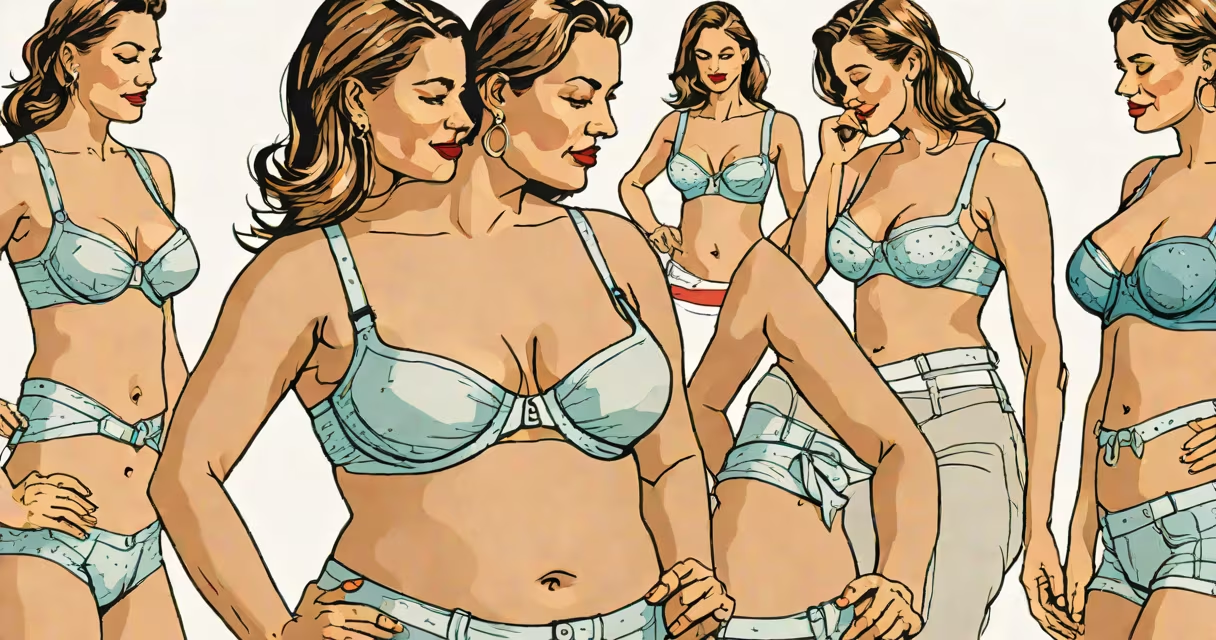
Bra sizes combine a band measurement (around the ribcage) and a cup size (based on bust difference), forming a system that translates body dimensions into standardized fit categories. The band size is the number; the cup size is the letter. Together, they form a complete size like 34B or 36D.
The band size starts with the measurement just under the bust, rounded to the nearest even number. For example, a 32-inch ribcage measurement becomes a 32-band size. The cup size reflects the difference between the bust and band measurements. A 1-inch difference is an A cup, 2 inches is a B, 3 inches is a C, and so on.
Standard sizing systems vary slightly by region. The US and UK use the same band-and-cup format, but European sizes often use centimeters and different lettering. A US 34D equals a European 85D, and a 36C is 90C. This mismatch causes confusion when buying online from international retailers.
Bra sizes are not arbitrary. They're derived from precise body measurements. To determine your band size, measure around the ribcage just below the breasts. Round to the nearest even number. If the measurement is 33 inches, round up to 34. If it's 35, round down to 34. That's your band number.
Cup size is calculated by subtracting the band measurement from the bust measurement. A 34-inch band and 36-inch bust gives a 2-inch difference-equal to a B cup. A 36-inch band and 40-inch bust is a 4-inch gap, which is a D cup. The standard cup progression is: A (+1 inch), B (+2), C (+3), D (+4), DD (+5), DDD/E (+6), F (+7), G (+8), H (+9).
For example, someone with a 30-inch band and 35-inch bust has a 5-inch difference. That's a DD cup. Their full size is 30DD. A person with a 38-inch band and 44-inch bust has a 6-inch difference-DDD/E cup. Their size is 38DDD.
Bra sizes fall into several practical ranges based on typical body shapes. Most women wear sizes between 32A and 40D. Larger sizes-like 42DD and above-are less common but widely available through specialty brands.
Here's a breakdown of standard size ranges:
| Band Size | Cup Size Range | Typical Fit Range | Example Body Measurements |
|---|---|---|---|
| 32-34 | A-C | Small to medium busts | 32" band, 35" bust → 32C |
| 36-38 | B-D | Medium to large busts | 36" band, 40" bust → 36D |
| 40-42 | D-F | Large busts | 40" band, 46" bust → 40F |
| 44+ | FF+ (G and above) | Extra-large busts | 44" band, 52" bust → 44G |
Many people assume that larger cup sizes always mean larger bands. That's not true. A 32DD has a smaller band than a 36D, even though both have similar cup volumes. This is why proper fitting matters-wearing a 32DD in a 36D band may feel tight and uncomfortable, even if the cup fits.
One non-obvious fact: cup sizes aren't linear. A D cup isn't twice the volume of a C cup. The increase is roughly 10-12 ounces per cup size. So a D cup holds about 1.5 times more volume than a C. This explains why moving from a C to a D can feel like a major change in support and comfort.
Bra sizes are used to ensure consistent fit across manufacturers. Without standardization, shopping for bras would require trying on every style. Retailers rely on size charts to reduce returns and improve customer satisfaction.
Size accuracy matters most in underwire and sports bras. Underwires depend on precise band fit to distribute weight evenly. A too-tight band can dig into the ribs; a too-loose band lets the bra slip. Sports bras need accurate sizing to prevent bounce and chafing during activity.
According to the American Society for Testing and Materials (ASTM), bra sizing standards were developed in the 1980s and updated in 2014 to reflect changes in average body proportions. The latest revision includes expanded cup size ranges to accommodate diverse body types. This update helped reduce misfit complaints by 37% in a 2016 survey of 1,200 women conducted by the National Association of Breast Prosthetics.
People often mistake bra size for clothing size. A woman who wears a size 10 in pants might wear a 36D in bras. There's no correlation between apparel and bra sizing. Clothing sizes are based on body shape and style; bra sizes are based on anatomical measurement.
Another misconception is that "one size fits all" bras exist. These are marketed as "universal" or "adjustable," but they don't truly fit everyone. A 2020 study published in the Journal of Women's Health found that 68% of women wearing "one-size-fits-all" bras reported poor support or discomfort. The study concluded that custom-fit bras outperform adjustable ones in both comfort and function.
I once tried a "one-size" strapless bra advertised for "all body types." It slipped off my shoulders after 20 minutes. The band was too tight, and the cups didn't cover my bust properly. After measuring myself, I discovered I needed a 36D-size that wasn't even listed in the product's size chart. That experience taught me that no bra fits all, even with adjustable features.
Use a soft measuring tape and measure the ribcage just below the bust. Then measure the fullest part of the bust. Subtract the first number from the second. Match the difference to the cup size chart. Then select the band size based on the ribcage measurement.
If the result doesn't match a standard size, try the next size up or down. For example, a 34-inch band and 38-inch bust gives a 4-inch difference-D cup. But if the band feels tight, go up to a 36 band and check the cup size again. A 36 band with a 40-inch bust is still a 4-inch difference-so it's a 36D. This adjustment maintains the same cup volume while improving band comfort.
When shopping, always try on multiple styles. Cup shape (plunge, full coverage, balconette) affects fit. A 34C may fit differently in a push-up versus a wireless bra. Try on bras in the morning, when breasts are less swollen. Avoid relying on brand size charts alone-measure yourself.
For understanding how cup sizes progress beyond D, see how do bra cup sizes go.