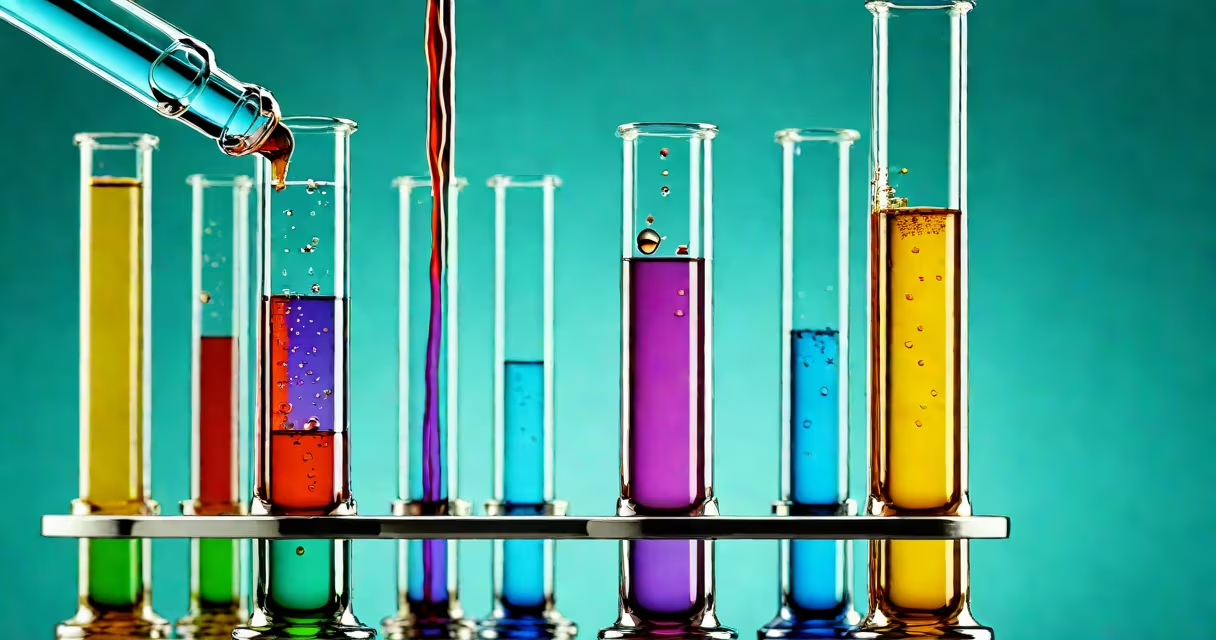
Chemistry is the scientific study of matter, its composition, structure, properties, and the changes it undergoes through chemical reactions. It explains how atoms bond, rearrange, and change into new substances under specific conditions.
At its core, chemistry reveals how elements combine in predictable ratios to form compounds. For example, two hydrogen atoms and one oxygen atom always form a water molecule (H₂O) under standard conditions. This consistency allows chemists to predict outcomes in labs, industries, and biological systems.
Chemistry operates through measurable principles. The law of conservation of mass states that matter cannot be created or destroyed in a closed system. When wood burns, the carbon and hydrogen in it react with oxygen to produce carbon dioxide and water vapor-total mass remains unchanged, even though the original material disappears.
Chemical processes follow physical laws. Reactions occur when atoms gain, lose, or share electrons to achieve stable electron configurations. The octet rule-where atoms seek eight valence electrons-explains why sodium (Na) donates an electron to chlorine (Cl), forming NaCl, common table salt.
Reactions are quantified using stoichiometry. For every mole of methane (CH₄) burned, one mole of oxygen (O₂) produces one mole of carbon dioxide (CO₂) and two moles of water (H₂O). These ratios allow precise calculations in fuel efficiency, pharmaceutical synthesis, and environmental modeling.
Energy drives chemical change. Exothermic reactions release heat-like burning propane in a grill. Endothermic reactions absorb energy, such as photosynthesis in plants, which uses sunlight to convert CO₂ and water into glucose and oxygen.
Chemistry divides into subfields based on focus areas. Each applies core principles to different domains.
| Type | Focus Area | Real-World Example |
|---|---|---|
| Organic Chemistry | Carbon-based molecules | Designing new antibiotics like penicillin derivatives |
| Inorganic Chemistry | Non-carbon compounds | Developing catalysts for industrial ammonia production (Haber process) |
| Analytical Chemistry | Identifying substance composition | Detecting trace lead in drinking water using atomic absorption spectroscopy |
| Physical Chemistry | Thermodynamics and reaction rates | Modeling how fast a drug dissolves in the bloodstream |
Each branch relies on shared foundational concepts: bonding theory, periodic trends, and reaction mechanisms. But they apply them differently. Organic chemists map complex pathways in drug development; analytical chemists ensure purity standards in food and medicine.
Many assume chemistry is only about dangerous chemicals or lab explosions. In reality, it governs everyday processes: digestion, rust formation, and even the flavor of coffee. A single cup involves over 800 volatile compounds interacting through thermal decomposition and oxidation.
Another misconception is that chemistry is purely experimental. While hands-on work is essential, modern chemistry integrates computational models. Density functional theory (DFT) simulations now predict molecular behavior before synthesizing a compound, reducing trial-and-error in materials science.
Some confuse chemistry with physics. Both study matter, but physics focuses on motion, forces, and energy at macroscopic and quantum levels. Chemistry examines how atoms connect and rearrange. For instance, while physics explains why electrons orbit nuclei, chemistry explains how those electrons enable covalent bonds in DNA's double helix.
Consider a car engine burning octane (C₈H₁₈), a hydrocarbon in gasoline. The balanced equation is:
2 C₈H₁₈ + 25 O₂ → 16 CO₂ + 18 H₂O + energyFor every 2 moles of octane, 25 moles of oxygen are consumed. This produces 16 moles of carbon dioxide and 18 moles of water vapor. The energy released powers the pistons.
This reaction illustrates multiple chemical principles: conservation of mass (total atoms remain constant), oxidation-reduction (oxygen gains electrons, carbon loses them), and thermodynamics (heat is produced).
Environmental impact follows directly from this chemistry. Each gallon of gasoline burned releases about 19.6 pounds of CO₂. That's why emissions regulations rely on chemical analysis of exhaust gases.
I once built a small-scale model of a catalytic converter using platinum mesh and simulated exhaust gases. Watching the conversion of nitrogen oxides (NOₓ) into nitrogen and oxygen confirmed how chemistry enables pollution control. The reaction rate increased dramatically when heated-proof that temperature affects molecular collision frequency.
Chemistry is not just about formulas-it's about causality. The meaning of chemistry includes predicting outcomes based on structure. For example, two molecules with identical formulas (isomers) behave differently because of spatial arrangement. Glucose and fructose both have C₆H₁₂O₆, but glucose supports cellular respiration while fructose is metabolized in the liver.
A lesser-known fact: the term "chemistry" originally referred to alchemy, a precursor focused on transmuting metals. Modern chemistry emerged from alchemical experimentation but replaced mystical explanations with reproducible experiments. Robert Boyle's 1661 book *The Sceptical Chymist* challenged the idea that elements were earth, air, fire, and water-laying groundwork for the periodic table.
According to the Royal Society of Chemistry, 95% of known substances are synthetic or modified versions of natural ones. This shows chemistry's role in innovation-not just discovery.
Understanding the meaning of chemistry means recognizing it as a predictive science. It enables engineers to design safer batteries, doctors to tailor treatments, and farmers to improve crop yields through fertilizers. Without it, modern life would lack clean water purification, vaccines, or digital devices.