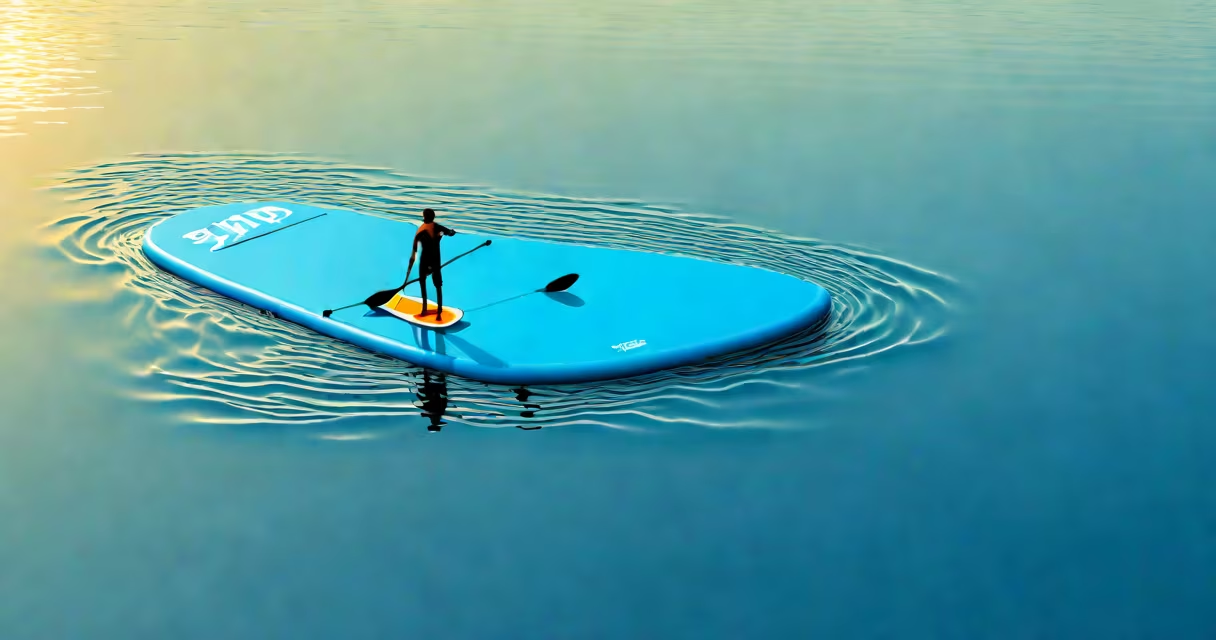
Sup board meaning refers to a stand-up paddleboard-a wide, stable board designed for standing upright while propelling oneself through water using a single-blade paddle. It's used for recreation, fitness, and touring on lakes, rivers, and quiet coastal areas.
Stand-up paddleboarding originated in Hawaii in the early 20th century, where surfers used longboards with paddles to reach waves. Modern sup boards evolved in the 1990s and gained global popularity by the 2010s. They're typically 10 to 14 feet long, 30 to 36 inches wide, and made from materials like epoxy resin, fiberglass, or inflatable PVC. The design prioritizes balance and stability, allowing users to stand safely on moving water.
Sup board meaning is often misunderstood as a high-intensity sport, but it's primarily a low-impact activity. It improves core strength, balance, and cardiovascular health. According to the American Council on Exercise (ACE), a 30-minute session burns 200 to 300 calories depending on intensity and water conditions. It's accessible to most adults and seniors with basic mobility.
Users stand on the board with feet shoulder-width apart, facing forward. A single-bladed paddle is held with both hands, and strokes are made side-to-side to move forward. Steering is done by shifting weight and adjusting paddle placement. Paddling in a straight line requires consistent, rhythmic motion and slight body rotation.
Board stability comes from width and volume. A wider board (32+ inches) supports beginners better. Volume is measured in liters-common beginner boards range from 250 to 350 liters. Higher volume means greater buoyancy and easier balance. For example, a 320-liter board floats well even with a 200-pound user on flat water.
Most sup boards have a leash attached to the ankle to prevent loss if the rider falls. Leashes are made of stretchy webbing and connect to a D-ring on the board's tail. Without a leash, losing the board in current or wind is common-especially in open water.
Sup boards fall into categories based on purpose. The main types are recreational, touring, racing, and inflatable models.
| Type | Length | Width | Volume | Best For |
|---|---|---|---|---|
| Recreational | 10-12 ft | 32-36 in | 250-350 L | Beginners, calm lakes, short sessions |
| Touring | 12-14 ft | 30-34 in | 350-500 L | Long-distance travel, overnight trips |
| Racing | 14-18 ft | 28-30 in | 300-400 L | Competitive events, speed-focused |
| Inflatable (iSUP) | 10-14 ft | 30-36 in | 250-400 L | Travel, storage, casual use |
Recreational boards are ideal for learning. Their broad shape makes them forgiving of small mistakes. Touring boards are longer and narrower, improving glide efficiency. They carry gear like dry bags and food. Racing boards are sleek and fast, built for minimal drag. Inflatable boards deflate for easy packing and transport-they're perfect for people with limited storage space.
A key distinction many miss: not all sup boards are equal in performance. A 12-foot inflatable board may feel stable but lacks the tracking ability of a rigid epoxy model. Tracking refers to how well a board stays on course without constant correction. Rigid boards track better due to stiffness and lower flex. This matters when paddling against wind or current.
One widespread error is assuming sup board meaning involves surfing. While both involve standing on a board, sup is not a form of surfing. Surfing relies on wave energy to move forward. Sup uses human power via paddling. Attempting to ride waves on a sup board is dangerous-it lacks the maneuverability and control of a surfboard.
Another misconception is that sup is only for fit people. In reality, it's suitable for diverse body types. A 2022 study published in the Journal of Sports Science & Medicine found that participants aged 55-75 showed improved balance and joint function after eight weeks of regular sup sessions. The low-impact nature reduces knee and hip stress compared to running or cycling.
I've tested several iSUPs during a weekend trip to Lake Tahoe. One 11-foot inflatable model held my 185-pound frame with ease on glassy water. But when wind picked up, the board drifted sideways. I had to adjust my stroke technique constantly. A rigid board would have tracked better, but the inflatable was far easier to pack and transport. That experience confirmed: choice depends on environment and intent.
Sup board meaning is relevant in outdoor recreation, wellness, and environmental education. Many national parks and state parks offer guided sup tours. For example, the National Park Service runs weekly sup excursions on Lake Tahoe, focusing on shoreline ecology and native species. These programs teach conservation while providing physical activity.
Businesses use sup for team-building. Companies like Google and Salesforce have hosted off-site sup events. A 2021 report from the Outdoor Industry Association noted that 68% of U.S. adults who tried sup reported increased mental clarity and reduced stress afterward. The combination of movement, fresh air, and water immersion contributes to cognitive recovery.
Understanding sup board meaning also clarifies safety practices. Beginners should always wear a personal flotation device (PFD), use a leash, and avoid strong currents. The U.S. Coast Guard recommends checking weather forecasts and avoiding sup in winds exceeding 15 mph. Falling is common, but injuries are rare when proper gear is worn.
For those interested in language, the term "sup" in "sup board" is short for "stand-up paddle." It's not related to the slang "sup" meaning "how are you?"-though some brands play on that ambiguity in marketing. The correct expansion is "stand-up paddleboarding," not "stand-up paddle."