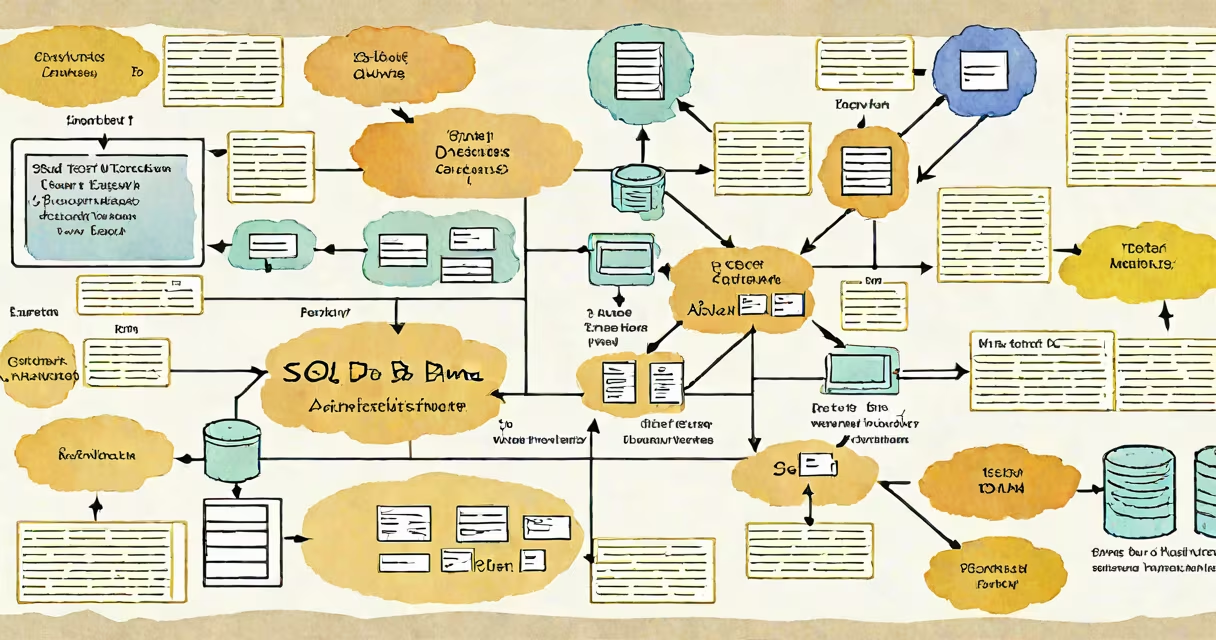
SQL DBMS software is a system that stores, organizes, and retrieves structured data using the Structured Query Language (SQL). It enables users to create, manage, and query databases through standardized commands. This category includes products like Microsoft SQL Server, Oracle Database, PostgreSQL, and MySQL.
At its core, SQL DBMS software uses a relational model where data is stored in tables composed of rows and columns. Each table represents an entity-like customers or orders-and relationships between tables are defined via keys. Users interact with the system through SQL statements such as SELECT, INSERT, UPDATE, and DELETE to manipulate data.
These systems enforce data integrity through constraints, support concurrent access by multiple users, and provide backup and recovery mechanisms. They run on servers or cloud platforms and serve applications ranging from e-commerce sites to financial transaction systems.
When a user sends an SQL command, the DBMS parses the syntax, checks permissions, optimizes the execution plan, and then accesses the underlying storage layer. The query optimizer selects the most efficient way to retrieve data based on indexes, table size, and available resources.
For example, a query like SELECT name FROM customers WHERE city = 'New York' triggers a search through an index on the city column. If the index exists, the DBMS finds matching rows quickly without scanning every record. Without indexing, performance degrades -especially in large datasets.
Transactions are handled using ACID properties: Atomicity, Consistency, Isolation, and Durability. A bank transfer involving two accounts must either complete entirely or fail completely. If a power outage occurs during the process, the DBMS rolls back changes to preserve consistency.
SQL DBMS software falls into three main categories based on deployment and scale:
| Type | Use Case | Examples | Scale |
|---|---|---|---|
| Enterprise | Large-scale business operations | Oracle Database, IBM Db2 | Thousands of concurrent users |
| Open-source | Web apps, startups, development | PostgreSQL, MySQL | From small to medium workloads |
| Cloud-native | Scalable, managed services | Amazon RDS, Google Cloud SQL | Auto-scaling environments |
Enterprise systems offer advanced security, replication, and high availability features. Open-source tools like PostgreSQL allow customization and lower licensing costs. Cloud-native options reduce infrastructure overhead by handling backups, patching, and scaling automatically.
Despite shared SQL syntax, differences exist in feature sets. For instance, Oracle supports PL/SQL for procedural logic, while PostgreSQL extends SQL with JSON support and custom functions. These variations affect portability-migrating a database from one system to another often requires rewriting queries or adjusting schema definitions.
Many assume that SQL DBMS software is synonymous with "database." But a database is a collection of data; the DBMS is the software that manages it. Confusing the two leads to miscommunication in technical planning and troubleshooting.
Another misconception is that all SQL DBMS software behaves identically. In reality, behavior varies across implementations. For example, MySQL treats date arithmetic differently than PostgreSQL. A query that runs in one system may fail or return unexpected results in another due to strictness in type checking or default settings.
A lesser-known fact: some SQL DBMS software includes built-in machine learning capabilities. Oracle Autonomous Database uses AI to tune performance and detect anomalies. PostgreSQL integrates with external tools like MADlib for statistical analysis. These features blur the line between traditional DBMS and analytics platforms.
A retail chain uses PostgreSQL as its central database for inventory, sales, and customer data. Each store submits daily sales records via a mobile app. The system processes 10,000 transactions per hour across 50 locations.
When a manager requests a report on monthly sales by region, the DBMS executes a complex query joining the sales, product, and location tables. It filters data by date range, groups results by region, and calculates totals-all within 1.2 seconds. This speed relies on pre-built indexes on the date and region fields.
The system also logs all changes to audit compliance. When a discrepancy appears in the monthly report, the DBA reviews transaction logs to trace the origin. The DBMS's built-in rollback feature allows restoration to a known good state within minutes.
This setup demonstrates how SQL DBMS software handles scale, accuracy, and reliability under real-world conditions.
SQL DBMS software is not the same as file-based storage like Excel spreadsheets or flat files. While both can hold tabular data, they lack transaction control, concurrency management, and query optimization. Attempting to scale spreadsheet-based systems to thousands of users results in corruption, slow response times, and data loss.
It's also distinct from NoSQL databases like MongoDB or Cassandra. Those systems prioritize flexibility and horizontal scalability over strict schema enforcement and ACID compliance. Choosing between SQL and NoSQL depends on whether your data follows predictable patterns or evolves rapidly.
As someone who built a small inventory system using SQLite, I learned early that even lightweight SQL DBMS software requires proper design. After adding 500+ entries, queries slowed dramatically until I added an index on the product ID field. That single change reduced response time from 3 seconds to under 100 milliseconds.
Modern applications depend on consistent, accurate data. SQL DBMS software helps information remains correct across updates, deletions, and failures. It enables reporting, analytics, and automation at scale.
According to the Gartner 2023 report, 87% of enterprises use SQL-based databases for mission-critical systems. The PostgreSQL Global Development Group confirms that PostgreSQL powers over 30 million installations worldwide, including major platforms like Instagram and Netflix.
Understanding how SQL DBMS software functions helps developers, analysts, and IT teams make better decisions about data architecture, performance tuning, and long-term maintenance.
SQL DBMS software is essential for managing structured data reliably. Its role spans from personal projects to global enterprise systems. Knowing its capabilities and limitations prevents costly mistakes in design and deployment.