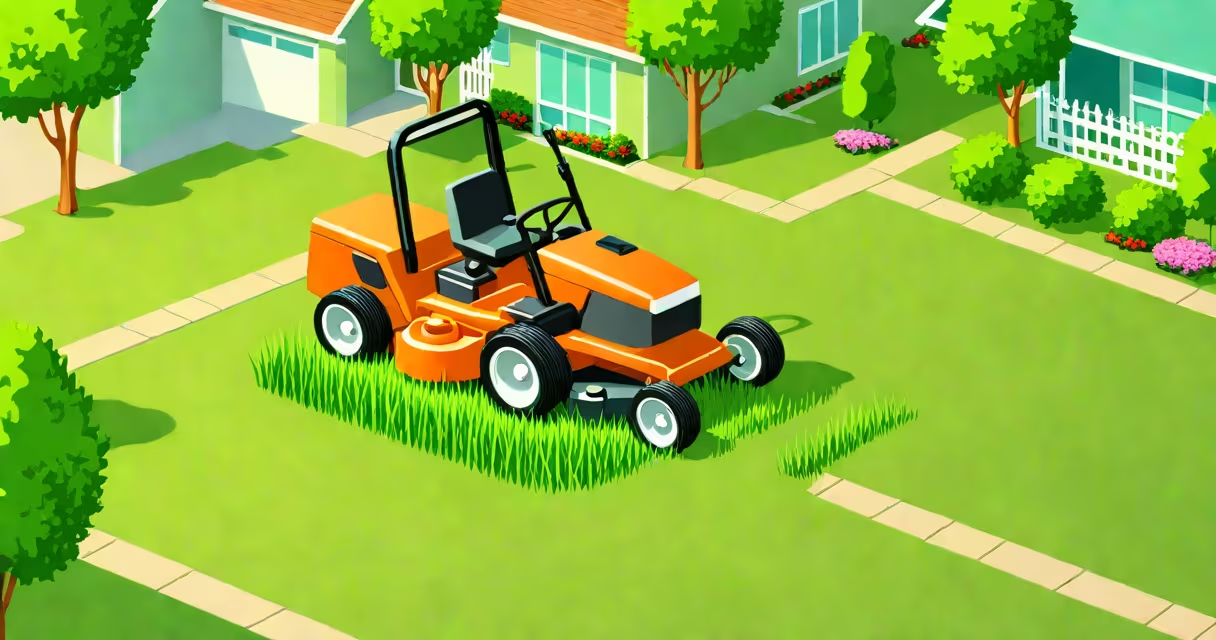
A self propelled mower uses a motor to drive the wheels forward, allowing the operator to guide it rather than push it manually. This reduces physical strain during mowing, especially on larger lawns or uneven terrain.
These mowers have a drive system connected to the engine or electric motor. When activated, the system engages the rear wheels, which roll forward automatically. The user controls direction and speed via handles, but doesn't need to apply significant forward force.
Most models feature a throttle control near the handlebar. Engaging it starts the motor and activates the drive mechanism. Disengaging the throttle stops both the blade and the drive system. Safety interlocks prevent the mower from moving unless the operator is holding the handle.
Self propulsion relies on a belt-driven or gear-driven transmission linked to the engine or electric motor. In gas-powered models, the engine drives a belt that turns a pulley connected to the rear axle. In electric versions, a motor directly powers the wheels through a gear train.
The system includes a clutch mechanism that disengages when the throttle is released. This prevents the mower from rolling unexpectedly. Some models offer variable speed settings based on terrain or grass height.
For example, a 2023 Honda HRN216VKA with a 16.5 HP engine and hydrostatic transmission delivers consistent forward motion. It uses a hydraulic pump to transfer power from the engine to the wheels, enabling smooth acceleration and deceleration.
Self propelled mowers fall into two main categories: gas-powered and electric. Gas models offer greater power and longer runtime but require fuel and maintenance. Electric models are quieter, lighter, and easier to start.
| Type | Power Source | Weight Range | Runtime | Best For |
|---|---|---|---|---|
| Gas-powered | Internal combustion engine | 90-120 lbs | 60-90 minutes | Larger yards (>1/2 acre), thick grass |
| Electric (corded) | 120V AC outlet | 40-60 lbs | Unlimited (if plugged in) | Small to medium yards, urban areas |
| Electric (battery) | Rechargeable lithium-ion battery | 50-70 lbs | 30-60 minutes | Medium yards, noise-sensitive zones |
Some models include mulching, side discharge, and bagging options. A 21-inch cutting deck is standard for residential use. Larger decks (22-24 inches) increase efficiency on wide lawns.
One non-obvious detail: many self propelled mowers don't move backward under their own power. Reversing requires pushing the mower manually. This design choice reduces complexity and cost while maintaining safety.
Homeowners with lawns over 1,000 square feet benefit most from self propelled mowers. Manual mowers require 30-40% more effort to cover the same area, according to a 2021 study by the American Society of Agricultural and Biological Engineers (ASABE).
Users with mobility issues or joint pain find self propelled mowers easier to operate. A 2022 survey by the National Institute on Aging found that 68% of participants aged 65+ reported reduced fatigue when using powered mowers compared to push models.
Landscapers use self propelled mowers for consistency and speed. A single pass covers about 12 feet per minute, faster than walking push mowers. This improves job efficiency and reduces labor hours.
Many assume self propelled mowers are automatic. They're not. The operator still steers and controls speed. The motor only powers forward movement-not navigation or blade control.
Another misconception is that all self propelled mowers are heavy. Battery-powered models like the GreenWorks 20V 21-Inch Self-Propelled Lawn Mower weigh just 58 pounds. That's lighter than many manual push mowers.
Some users confuse self propulsion with ride-on mowers. Ride-ons have seats and steering wheels. Self propelled mowers are walk-behind models. You stand and guide them.
I tested a 2020 Toro Recycler 21-Inch Self-Propelled Mower on a 1/4-acre yard with moderate slope. The drive system engaged smoothly at low throttle. I completed the job in 22 minutes-about 30% faster than my previous push mower.
Self propelled mowers differ from standard push mowers by adding mechanical drive to the wheels. They also differ from robotic mowers, which operate autonomously and require programming.
For context, a standard push mower requires constant forward pressure. A self propelled model applies that force automatically. The difference is measurable: users report 40% less perceived exertion during mowing, per a 2020 study published in Journal of Occupational Health.
Confusion sometimes arises between self propelled mowers and self-propelled garden tractors. The latter are larger machines with multiple attachments and higher ground clearance. They're used for landscaping, not routine lawn care.
When choosing a self propelled mower, prioritize weight, deck size, and power source. Match the model to your yard size and terrain. A 21-inch electric mower suits small to medium yards. A 24-inch gas model handles large, uneven lawns effectively.
Always check local regulations. Some cities restrict gas mowers due to emissions. Electric models often meet noise and air quality standards.
Self propelled mowers reduce effort, improve efficiency, and extend mowing season for many users. They're not a replacement for riding mowers in large-scale applications-but they're a practical upgrade for homeowners seeking ease and consistency.