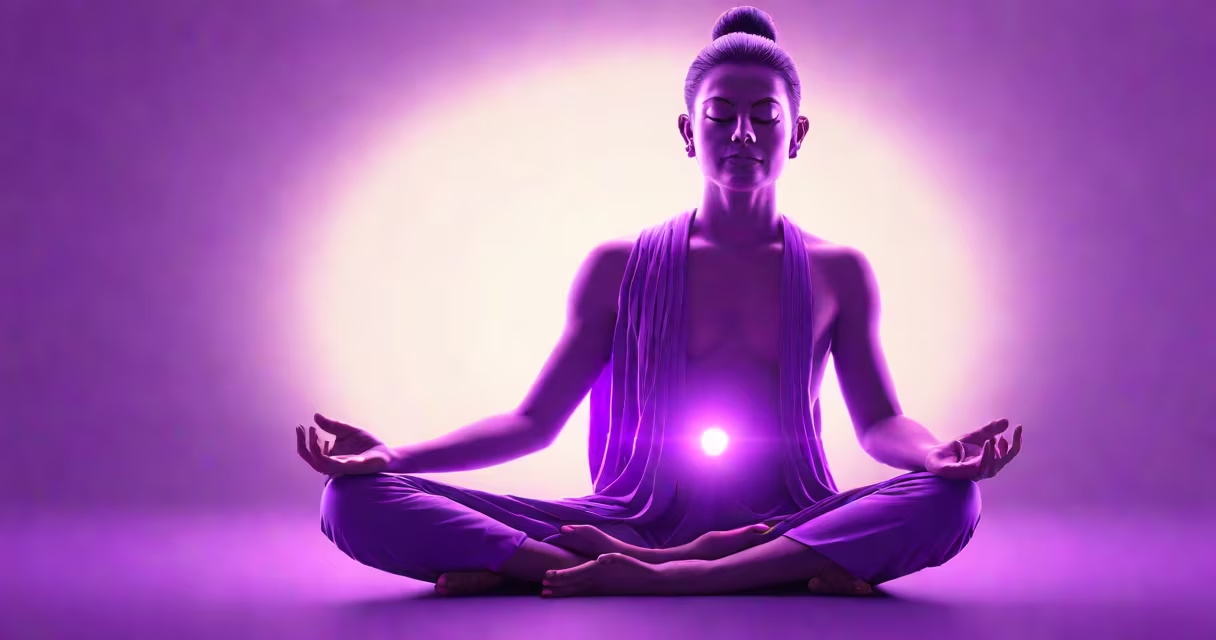
Seeing purple in meditation is a reported visual phenomenon where individuals perceive a violet or lavender hue during deep focus or mindfulness practice. It typically appears as a faint glow, color field, or pattern behind closed eyelids and is not a sign of illness or altered reality.
This experience falls under the category of spontaneous visual imagery, often triggered by sustained concentration or reduced sensory input. It's not unique to any belief system-people across cultures and faiths report similar sensations during stillness.
Neuroscience suggests that such phenomena arise from internal brain activity, particularly in the visual cortex, when external stimuli are minimized. The color purple may emerge due to neural noise patterns or increased alpha wave activity associated with relaxed wakefulness.
When you close your eyes and meditate, your visual system doesn't shut off-it shifts into a state of low-level activation. The brain continues processing signals even without external input, leading to spontaneous images, shapes, and colors.
Studies using EEG have shown that during quiet meditation, alpha waves (8-12 Hz) increase in the occipital lobe-the region responsible for visual processing. This heightened activity can generate phosphenes: flashes of light or color perceived without actual light entering the eye.
One study published in Nature Neuroscience found that subjects in a darkened room reported seeing geometric patterns and colors, including purple, when their visual cortex was stimulated via transcranial magnetic stimulation. This supports the idea that color perception during meditation stems from internal neural dynamics, not external sources.
The appearance of purple in meditation is not a physical object or energy. It's a perceptual event generated by the brain's interpretation of internal signals. There's no evidence that it reflects spiritual insight, chakra activation, or divine communication.
Common triggers include:
Some people report seeing purple more frequently during certain practices like loving-kindness meditation or body scan routines, likely because these methods amplify awareness of internal states.
While purple is commonly reported, other colors appear too. The most frequent hues include white, yellow, blue, and green. Purple tends to emerge later in meditation sessions, often after 10-20 minutes of sustained focus.
| Color | Typical Timing | Associated Brain State |
|---|---|---|
| Purple/Lavender | 10-30 min | Alpha dominance, relaxed alertness |
| White/Golden | 5-15 min | Increased gamma activity, focus peak |
| Blue/Gray | 15-45 min | Theta waves, deep calm |
| Red/Orange | Early stage | High arousal, initial effort |
These patterns align with research from the Journal of Cognitive Enhancement, which tracked neural oscillations during 30-minute guided meditations. Participants who reported seeing purple showed elevated alpha power and decreased beta wave activity-indicating reduced mental chatter.
Seeing purple in meditation is not something practitioners aim for. It's a side effect of prolonged stillness, not a goal. However, some teachers reference it to help students recognize progress in focus or inner quiet.
For example, in the Insight Meditation Society's retreat guidelines, instructors note that "color phenomena are normal" and suggest not engaging with them. They advise returning attention to the breath rather than analyzing the sight.
People sometimes misinterpret the experience as a sign of enlightenment or psychic ability. But experts caution against assigning meaning to these perceptions. As Dr. Andrew Newberg, a neuroscientist studying meditation, wrote in Why God Won't Go Away, "The brain generates visions during meditation-but they don't prove anything about the soul."
Many assume that seeing purple means they've accessed higher consciousness or awakened a chakra. This is incorrect. There's no scientific basis linking specific colors to energy centers in the body.
Another mistake is thinking the color indicates a problem. Some worry it's a symptom of migraines, hallucinations, or neurological disorders. But unless accompanied by pain, disorientation, or loss of coordination, it's harmless.
A key distinction: visual phenomena in meditation differ from hallucinations. Hallucinations involve false perceptions of external reality-like hearing voices or seeing people. In contrast, seeing purple during meditation occurs entirely within the mind and disappears when attention shifts.
One non-obvious fact: the color purple is more likely to appear in people who have previously experienced vivid dreams or high levels of imagination. A 2021 study in Consciousness and Cognition found that individuals with rich dream recall were 3.6 times more likely to report colored visuals during meditation.
I sat in silent meditation for 22 minutes during a weekend retreat. After 15 minutes, a soft purple haze began to form in my peripheral vision. It pulsed gently, like a heartbeat. I didn't react. I returned to my breath. After five minutes, the color faded. No sound, no emotion-just presence.
Later, a teacher explained that this was a typical occurrence. He said, "Purple shows up when the mind stops fighting. It's not special. It's just a sign you're quiet." That moment helped me stop seeking meaning in every sensation.
If you see purple during meditation, do nothing. Don't name it, analyze it, or try to hold onto it. Let it pass like a cloud.
Use it as a cue to return to your anchor-breath, body, or mantra. The goal isn't to experience colors. It's to develop awareness without attachment.
As the Center for Mindfulness in Medicine, Health Care, and Society advises, "When distractions arise-even beautiful ones-gently redirect attention. That's the practice."
Seeing purple in meditation is a natural, non-threatening phenomenon rooted in brain function, not mysticism. It's not a sign of awakening, nor a warning. It's simply a signal that your mind has entered a state of deep stillness.
Understanding this helps prevent misinterpretation and reduces anxiety. The experience fades when you stop focusing on it. The real benefit lies not in the color, but in the ability to observe it without reaction.