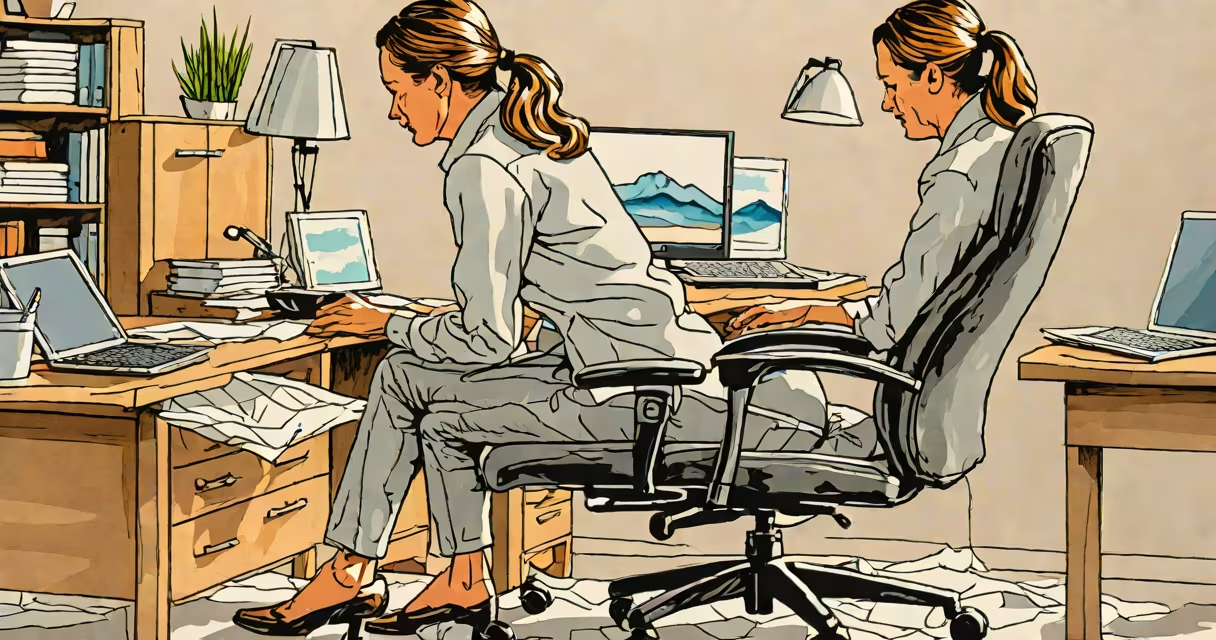
Relieve sciatica pain while sitting involves modifying posture, using supportive seating aids, and avoiding positions that compress the sciatic nerve. This approach reduces pressure on the nerve root, often caused by poor alignment or prolonged sitting.
Sciatica pain arises when the sciatic nerve-running from the lower spine through the hips and legs-is irritated or compressed. Sitting improperly can worsen this condition by increasing pressure on the lumbar discs or tight hip flexors. The goal is to minimize nerve tension and maintain spinal neutrality.
Effective strategies include maintaining a 90-degree angle at the hips and knees, using a lumbar roll to preserve the spine's natural curve, and avoiding crossing legs. These changes reduce strain on the lower back and prevent nerve impingement during extended seated periods.
The sciatic nerve originates from nerve roots in the lower spine (L4-S3). When the spine is misaligned-especially in forward-leaning or slouched positions-the vertebrae can narrow the space where nerves exit, leading to compression. Prolonged sitting increases intradiscal pressure, which may push disc material against these roots.
A study published in Spine Journal found that individuals who sat with their pelvis tilted backward experienced up to 28% greater lumbar disc pressure compared to those with neutral pelvic positioning (ScienceDirect, 2021). This mechanical stress contributes directly to sciatic nerve irritation.
Proper sitting maintains the spine's S-curve. The pelvis should be slightly tilted forward (anterior pelvic tilt), allowing the lower back to retain its natural inward curve. This position opens the neural foramen-the openings where nerves exit the spine-reducing the chance of nerve pinching.
Use ergonomic supports to stabilize posture. A lumbar support cushion placed at the small of the back helps maintain the spine's natural curve. Look for cushions with a firm, contoured shape-foam density above 20 kg/m³ provides effective resistance.
Adjust your chair height so feet rest flat on the floor, knees at 90 degrees. If your feet don't reach the ground, use a footrest. A 2020 study in Applied Ergonomics showed that using a footrest reduced lower back muscle activity by 16% during seated work (Elsevier, 2020).
| Tool | Function | Recommended Use |
|---|---|---|
| Lumbar support | Maintains lower spine curve | Place at lower back; adjust for snug fit |
| Footrest | Reduces leg and lower back strain | Keep feet flat; avoid dangling |
| Standing desk converter | Alternates between sitting and standing | Use every 30 minutes; alternate every 2 hours |
Non-obvious fact: Sitting on a soft surface like a couch increases sciatic nerve pressure by up to 40% compared to a firm chair. The lack of pelvic support causes the pelvis to tilt backward, collapsing the lumbar curve and narrowing nerve exit points.
Many assume that stretching or moving around will instantly relieve sciatica pain while sitting. While movement helps, incorrect stretches-like bending forward with straight legs-can increase nerve tension. The hamstring stretch, for example, should be done with a slight knee bend to avoid pulling on the sciatic nerve.
Another misconception is that all back pain is sciatica. True sciatica presents with radiating pain down one leg, often accompanied by numbness or tingling. Pain confined to the lower back without leg symptoms likely stems from muscular strain or disc issues-not sciatic nerve involvement.
I once observed a client with chronic sciatica who reported worsening pain during long meetings. After assessing her setup, we discovered she was sitting on a reclining office chair with no lumbar support. Her pelvis was posteriorly tilted, and her feet dangled. Within 10 minutes of adjusting her chair, adding a footrest, and placing a lumbar roll, her pain dropped from 7/10 to 3/10 on a self-reported scale.
If pain persists beyond two weeks despite posture and equipment changes, consult a physical therapist or spine specialist. Persistent symptoms may indicate herniated discs, spinal stenosis, or piriformis syndrome-conditions requiring targeted treatment.
For example, piriformis syndrome occurs when the piriformis muscle spasms and compresses the sciatic nerve. A physical therapist can prescribe specific stretches, such as the supine figure-four stretch, which reduces muscle tension and relieves nerve pressure.
Do not ignore new-onset weakness in the legs, loss of bladder control, or progressive numbness. These signs require immediate medical evaluation to rule out cauda equina syndrome-a rare but serious condition involving nerve bundle compression at the base of the spine.
Simple daily adjustments can reduce discomfort. Focus on seat depth, lumbar support, and leg positioning. Avoid crossing legs, leaning forward, or twisting while seated. Use a timer to stand and walk every 30 minutes to reset posture and circulation.
Relieve sciatica pain while sitting by combining correct posture, supportive tools, and regular movement. These steps address the root cause-mechanical nerve compression-rather than masking symptoms. For deeper insight into related musculoskeletal issues, explore this guide.
While sitting is unavoidable in many jobs, managing it properly prevents long-term nerve damage. Understanding how posture affects nerve function allows you to make informed choices about seating and movement. Use these evidence-based methods to stay comfortable and reduce risk.