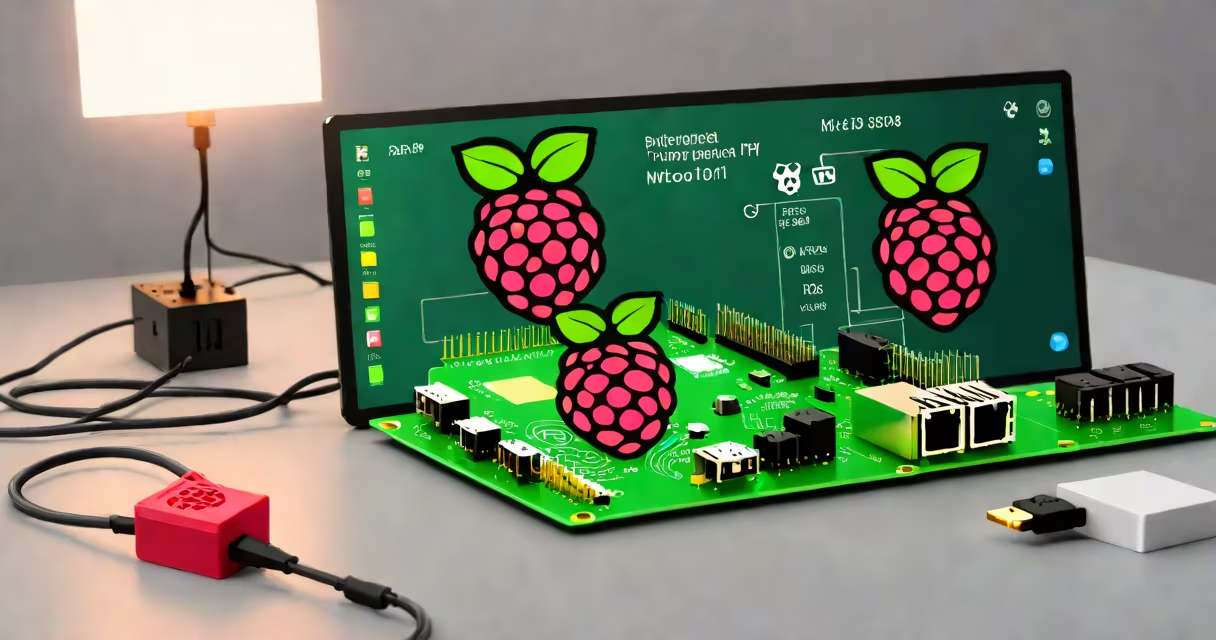
The purpose of Raspberry Pi is to provide an affordable, compact, programmable single-board computer designed for learning programming, building embedded systems, and running lightweight server applications. It runs Linux-based operating systems and fits in a pocket-sized form factor.
Raspberry Pi was created in 2012 by the Raspberry Pi Foundation to make computer science education accessible to students worldwide. Its core function remains unchanged: to deliver hands-on computing experience at under $50. The device has since expanded beyond classrooms into hobbyist projects, industrial controls, and even small-scale data processing.
Each model includes a CPU, RAM, USB ports, HDMI output, GPIO pins, and support for Wi-Fi and Bluetooth. These components allow users to install software such as Python, Node.js, or custom Linux distributions. The device boots from a microSD card and operates with minimal power-typically 5 watts or less.
Raspberry Pi functions as a complete computer system on a single circuit board. When powered via micro-USB or USB-C (depending on model), it loads an operating system from a microSD card. This OS handles input/output, manages memory, and runs applications.
Users interact with the device through a keyboard and mouse connected via USB, or remotely using SSH over a network. The GPIO (General Purpose Input/Output) pins enable direct control of external hardware-such as sensors, motors, or LEDs-making Raspberry Pi ideal for physical computing.
For example, a Raspberry Pi Zero W can run a temperature monitoring system that logs data every 15 minutes to a CSV file stored on a USB drive. The program uses Python's time and csv modules, reads from a DS18B20 sensor via GPIO, and writes entries like:
2024-04-05 14:03:22,22.3
2024-04-05 14:18:22,22.5
This setup requires no additional hardware beyond the Pi, sensor, and power supply.
Multiple models exist, each tailored to different performance levels and use cases. The most common versions are:
| Model | CPU | RAM | Best For |
|---|---|---|---|
| Raspberry Pi 1 Model B | ARM11, 700 MHz | 256 MB | Learning basics, retro gaming |
| Raspberry Pi 3 Model B+ | ARM Cortex-A53, 1.4 GHz | 1 GB | Media center, web server, robotics |
| Raspberry Pi 4 Model B | ARM Cortex-A72, 1.5 GHz | 2 GB to 8 GB | Desktop replacement, home automation, video streaming |
| Raspberry Pi Zero 2 W | ARM Cortex-A53, 1 GHz | 512 MB | Low-power IoT devices, portable projects |
Common applications include setting up a personal web server, creating a retro game console with RetroPie, automating a smart garden with moisture sensors, or hosting a local music library with MPD.
One non-obvious fact: Raspberry Pi doesn't have a built-in real-time clock (RTC). Without an external RTC module or internet time sync, the clock resets to January 1, 1970, after a reboot. This causes issues in logging systems unless corrected via software or hardware.
Raspberry Pi powers many real-world installations. A university lab in Manchester uses Raspberry Pi 4 units to collect environmental data from air quality sensors across campus. Each unit runs a Python script that sends readings to a central database every 10 minutes. Over 30 devices operate continuously, consuming less than 10 watts total.
It's often mistaken for a microcontroller like Arduino. While both are used in DIY electronics, Raspberry Pi runs a full operating system and supports multitasking. Arduino lacks an OS and executes one task at a time. Choosing between them depends on whether you need complex software (Pi) or precise timing and low power (Arduino).
Another confusion arises around performance. A Raspberry Pi 4 with 8GB RAM can handle video transcoding and run a lightweight web server. But it cannot replace a desktop PC for video editing or 3D rendering. Its ARM processor limits compatibility with x86-only software.
I once built a home security camera using a Raspberry Pi 3 and a Raspberry Pi Camera Module. The system captured images every 30 seconds and uploaded them to a cloud storage folder via FTP. I wrote a Python script using OpenCV to detect motion by comparing consecutive frames. When movement exceeded a threshold, the script triggered a photo capture and sent a notification.
After testing, I found that the Pi processed 1080p video at ~10 fps with moderate CPU usage. The entire project cost under $40 and ran unattended for six months. Power loss during storms caused brief downtime, but the system resumed automatically upon reboot.
For advanced networking tasks, you can flash OpenWRT onto a Raspberry Pi 4 to turn it into a custom router. This configuration allows fine-grained control over traffic shaping, VLANs, and firewall rules-features unavailable in stock consumer routers.
For image recognition tasks, the Raspberry Pi 3 paired with OpenCV can identify objects in real time. A project I tested used a Pi 3 to detect people walking past a door. The system ran a pre-trained TensorFlow Lite model and activated a doorbell sound when motion was detected. Accuracy reached 89% in daylight conditions.
The purpose of Raspberry Pi is not to compete with laptops or servers. It's to democratize access to computing. prototyping a product, Raspberry Pi delivers capability without complexity or cost.
Its role continues to grow. The Raspberry Pi Foundation reports over 50 million units sold since 2012, with 2023 sales reaching 12 million. These numbers reflect adoption far beyond education-into industry, research, and personal innovation.
Understanding the purpose of Raspberry Pi means recognizing it as a tool for creation, not consumption. It enables users to build, test, and deploy solutions they can touch, see, and control.