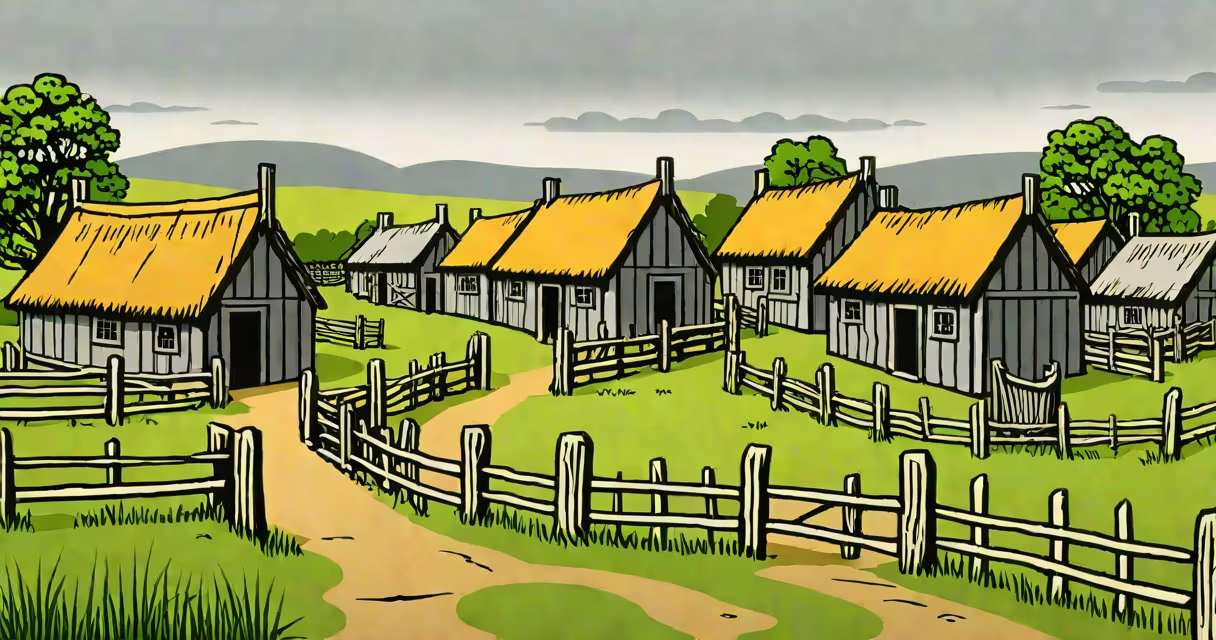
Old English history spans from the 5th century CE to the late 11th century, covering the period when Germanic-speaking settlers-Angles, Saxons, and Jutes-established kingdoms in Britain after the Roman withdrawal, leading to the formation of early English political and linguistic structures.
The term "Old English" refers to both the language spoken between approximately 450 and 1150 CE and the historical era during which it evolved. This period began with the migration of warrior groups from continental Europe, who settled in what is now England, displacing or assimilating the native Romano-British population. By the 7th century, seven major kingdoms-Northumbria, Mercia, East Anglia, Essex, Kent, Sussex, and Wessex-had emerged, forming a fragmented but culturally cohesive region.
These kingdoms were not unified until the 9th century, when Alfred the Great of Wessex resisted Viking invasions and laid the foundation for a centralized English state. The Viking raids, beginning in 793 with the attack on Lindisfarne, disrupted monastic life and led to the establishment of the Danelaw-a zone of Danish control in eastern and northern England. The conflict culminated in the Treaty of Wedmore (878), which recognized Alfred's authority over much of southern England while allowing Danish rule in the north and east.
Political consolidation occurred through warfare, alliances, and royal marriages. The unification of England under a single king was completed by Æthelstan in 927, who was crowned King of the English after defeating rivals including the Scots and Vikings. His reign marked the first time a single ruler held authority over all of what is now England.
Cultural development was driven by Christianization. The Gregorian mission of 597, led by Augustine of Canterbury, introduced Latin Christianity to the Anglo-Saxons. Monasteries became centers of learning, copying manuscripts, and producing religious texts. The Lindisfarne Gospels (c. 700), created in Northumbria, exemplify the fusion of Celtic, Anglo-Saxon, and Christian artistic traditions.
Literature flourished in this context. Beowulf, composed between 700 and 1000 CE, is the most famous surviving epic poem in Old English. It recounts the tale of a Geatish hero who battles monsters in Denmark and Sweden, reflecting heroic values such as loyalty, courage, and fate. The poem survives in a single manuscript, now housed in the British Library, and contains over 3,000 lines written in alliterative verse.
Society was structured around kinship, land ownership, and military service. The basic unit was the *comitatus*-a warrior band bound by loyalty to a lord. This relationship is central to Beowulf's narrative, where warriors pledge allegiance to their king in exchange for protection and spoils.
Land was divided into *hide* units, roughly equivalent to enough land to support one family. A *shire* was a larger administrative division, often corresponding to a county. The system of local governance included the *witan*-a council of nobles and bishops who advised the king and helped elect new rulers.
| Type | Description | Example |
|---|---|---|
| Kingdom | Independent political entity ruled by a king | Wessex under Alfred the Great |
| Monastery | Religious center for prayer, education, and manuscript production | Lindisfarne Priory |
| Shire | Administrative district for taxation and justice | Yorkshire, derived from the shire of Yorkshire |
Old English law was codified in multiple versions of the laws of Æthelberht of Kent (c. 600), the earliest known legal code in any Germanic language. These laws regulated fines for offenses such as theft, assault, and breach of contract, showing a complex understanding of social order and restitution.
Old English history forms the foundation of modern English identity, language, and institutions. Over 10,000 words in contemporary English derive from Old English roots. Words like *house*, *mother*, *earth*, and *king* trace directly to the language spoken in the 6th to 11th centuries.
Archaeological sites such as Sutton Hoo (discovered in 1939) provide physical evidence of elite Anglo-Saxon culture. The ship burial contained weapons, jewelry, and a helmet now recognized as a masterpiece of early medieval metalwork. Radiocarbon dating places the burial around 625 CE, aligning with the reign of King Raedwald of East Anglia.
Modern English place names reflect Old English origins. The suffixes *-ton* (village), *-ham* (homestead), and *-bury* (fortified town) appear in hundreds of towns and cities. For example, *Winchester* comes from *Wintan-ceaster*, meaning "fortress of the people of Woden."
Old English history is often misrepresented as a single, unified culture. In reality, the Anglo-Saxon period was marked by regional variation, internal conflict, and shifting power balances. The idea of a "golden age" of peace and prosperity is inaccurate-many regions experienced frequent warfare, especially during the Viking invasions.
A common error is equating "Anglo-Saxon" with "English" in a modern national sense. The term applies only to the Germanic-speaking peoples who settled in England between 450 and 600 CE. The modern nation-state of England did not exist until centuries later. The cultural and linguistic blend that formed modern English includes Norse, Latin, French, and other influences beyond the Anglo-Saxon core.
Another misconception is that Old English was a "primitive" language. It had a complex grammar with four cases (nominative, accusative, genitive, dative), three genders (masculine, feminine, neuter), and strong and weak verb conjugations. The language was capable of expressing abstract thought, philosophical ideas, and poetic imagery.
I spent a week translating excerpts from Beowulf using a 19th-century glossary and modern scholarly commentary. The passage describing Grendel's mother's lair-"hæfde hond on hroðe, þæt heo wæs eallum gryre" ("she had hands on the floor, that she was all covered in filth")-required careful parsing of compound words and kennings. The word *gryre* (filth) appears in only two other Old English texts, both religious. This rarity underscores how deeply context shapes interpretation.
Translating even short passages reveals the difficulty of rendering Old English into modern English without losing nuance. The original line uses alliteration ("hond on hroðe"), metaphor ("eallum gryre"), and syntactic ambiguity. Modern translations often simplify these features, obscuring the poem's layered artistry.
Old English history is not a static past. It lives in the structure of your sentences, the sound of your words, and the shape of your country's place names. It is not a relic-it is the origin story of a living language.