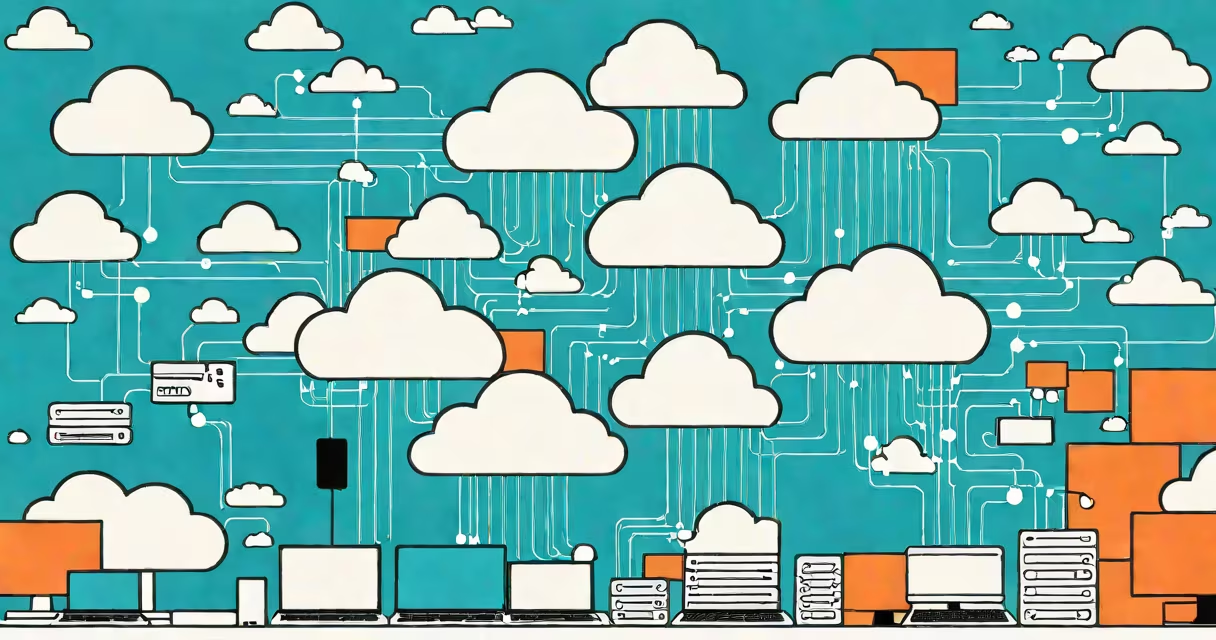
The meaning of cloud based refers to software, data, or services delivered over the internet from remote servers instead of being stored locally on a user's device or on-site infrastructure. This model enables access to resources from any location with internet connectivity, reducing the need for physical hardware and maintenance.
Cloud based systems operate on distributed networks managed by third-party providers such as Amazon Web Services (AWS), Microsoft Azure, or Google Cloud Platform. These providers maintain vast data centers housing thousands of servers that store and process information. When a user accesses a cloud based application, they connect to these remote systems through a network connection, often using a web browser or dedicated client software.
For example, when someone uses Gmail, they are interacting with a cloud based email service. The messages, contacts, and settings are not saved on their computer but instead reside on Google's global network of servers. Users can log in from any device-phone, tablet, or laptop-and retrieve their data instantly, regardless of location.
At its core, cloud based computing relies on virtualization and networked infrastructure. Virtual machines (VMs) simulate physical computers within a shared environment, allowing multiple users to run independent operating systems and applications on the same physical hardware. This maximizes resource efficiency and reduces costs.
Data is stored across geographically dispersed data centers. Redundancy helps even if one server fails, another takes over smoothly. For instance, AWS uses Availability Zones-physically separate locations within a region-to protect against outages. If a power failure occurs in one zone, traffic automatically shifts to another, maintaining uptime.
Security is enforced through encryption, multi-factor authentication, and role-based access controls. Data in transit is protected via TLS (Transport Layer Security), while data at rest is encrypted using AES-256 standards. According to NIST Special Publication 800-145, cloud computing involves on-demand network access to configurable pools of computing resources.
Cloud based offerings fall into three primary models:
| Service Type | Description | Common Use Cases |
|---|---|---|
| Infrastructure as a Service (IaaS) | Provides virtualized computing resources over the internet. Users rent servers, storage, and networking components. | Hosting websites, running databases, deploying custom applications. |
| Platform as a Service (PaaS) | Offers a platform allowing customers to develop, run, and manage applications without dealing with underlying infrastructure. | Developing mobile apps, building web services, testing software. |
| Software as a Service (SaaS) | Delivers software applications over the internet on a subscription basis. No installation required. | Email (Gmail), office suites (Microsoft 365), CRM tools (Salesforce). |
Each tier builds upon the previous one. IaaS gives raw infrastructure; PaaS adds development tools and runtime environments; SaaS delivers ready-to-use applications. Most businesses adopt SaaS for productivity tools due to low setup effort and automatic updates.
Organizations use cloud based platforms to scale quickly, reduce capital expenses, and improve reliability. A small e-commerce startup can launch with minimal upfront investment by using AWS Elastic Compute Cloud (EC2) to host its website and Amazon RDS for database management.
During peak shopping periods like Black Friday, demand spikes. With traditional on-premise servers, scaling requires purchasing new hardware months in advance. In contrast, cloud based systems allow changing scaling-adding more processing power during high traffic and releasing it afterward-often within minutes.
According to Gartner, 80% of organizations planned to migrate at least part of their workload to the cloud by 2023. The shift supports remote work, disaster recovery, and compliance with regulations like GDPR and HIPAA. For example, healthcare providers use HIPAA-compliant cloud services to securely store patient records while enabling doctors to access them from multiple clinics.
Many assume that "cloud based" means "unsecured." In reality, major cloud providers invest billions annually in cybersecurity. AWS spends over $1 billion yearly on security research and operations, including threat detection, penetration testing, and incident response teams.
Another myth is that moving to the cloud eliminates all IT responsibilities. While providers manage the underlying hardware, users still control data access, configuration, and patching. Misconfigurations remain a leading cause of data breaches. A 2022 report by Palo Alto Networks found that 73% of cloud security incidents stemmed from user error, not provider failure.
People often confuse "cloud based" with "online." Not all online services are cloud based. A website hosted on a single rented server isn't necessarily using cloud infrastructure. True cloud based systems rely on elasticity, automated failover, and distributed architecture-not just internet access.
I once visited a factory in Detroit that implemented a cloud based manufacturing system. They replaced legacy on-site servers with a solution hosted on Microsoft Azure. Sensors on production lines sent real-time data to the cloud, where analytics tools detected inefficiencies and predicted machine failures.
When a conveyor belt motor showed signs of overheating, the system alerted maintenance staff via a mobile app. Repairs were scheduled before breakdowns occurred. Over six months, downtime dropped by 40%, and energy consumption decreased by 18%. The entire system ran on a cloud based platform, accessible from any manager's smartphone.
This illustrates how cloud based systems aren't just for IT departments-they drive operational improvements across industries.
One non-obvious fact: cloud based doesn't always mean faster. Latency depends on geographic proximity to data centers. A user in Sydney accessing a server in Virginia may experience higher delays than if the server were located in Singapore. Providers offer regional zones to minimize this effect.
Another distinction: not all cloud based services are public. Private clouds exist within a company's own data center or a dedicated facility. They offer greater control and compliance but require more management. Hybrid models combine private and public clouds, letting companies keep sensitive data on-premise while offloading less critical workloads to public platforms.
Finally, cloud based applications differ from desktop software. While both perform tasks, cloud based apps update automatically and sync changes across devices. A document edited in Google Docs appears instantly on all linked devices. Desktop software typically requires manual downloads and restarts for updates.
Understanding the meaning of cloud based clarifies how modern digital life functions-from streaming video to managing finances. It's not magic-it's distributed computing, powered by global networks and standardized protocols.