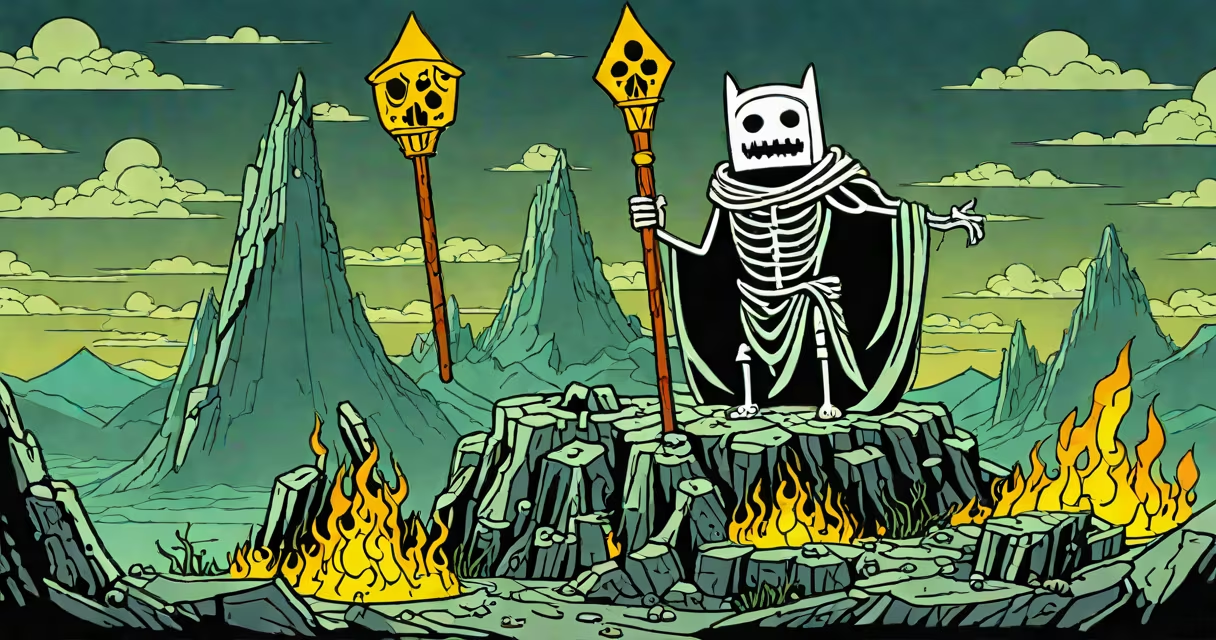
The lich in Adventure Time is a recurring antagonist and central figure in the show's later seasons, portrayed as a centuries-old undead being with immense magical power and a deep obsession with immortality. He appears in key episodes including "The Lich," "The Lich in the Mist," and "The Lich's Return," and plays a key role in the series' overarching narrative about death, rebirth, and emotional transformation.
Created by Pendleton Ward and developed by the Adventure Time creative team, the lich is not a traditional monster. He is a being who achieved godlike status through necromantic rituals and ancient magic, but whose pursuit of eternal life led to isolation, grief, and eventual redemption. His design features a skeletal frame wrapped in tattered robes, glowing green eyes, and a staff that channels dark energy. He speaks in a slow, deliberate tone, often quoting fragments of forgotten texts.
The lich's powers stem from his mastery of the "Book of the Living," a fictional grimoire said to contain spells for transcending death. He uses it to resurrect himself after being destroyed, making him nearly unstoppable. However, his immortality comes at a cost-he cannot feel emotion, cannot form relationships, and exists in perpetual loneliness. This internal conflict drives much of his behavior and makes him more than just a villain.
The lich operates on a cycle of destruction and rebirth. After being defeated in battle, he returns stronger, using his knowledge of ancient magic to rebuild his form. He targets the Land of Ooo not out of malice alone, but because he believes he is correcting a flaw in creation-the inevitability of death. He sees mortality as a mistake and seeks to erase it entirely.
His actions are rooted in trauma. In "The Lich," it's revealed that he was once a mortal named Mab, a scholar who studied the nature of existence. When his lover died, he attempted to bring her back through forbidden magic. The ritual failed, and he was transformed into a lich-a being neither alive nor dead. Over centuries, he lost his memories of who he was, retaining only the desire to end suffering through eternal stasis.
This backstory reshapes how viewers interpret his actions. He isn't evil by nature; he is broken by loss. His goal isn't to conquer Ooo, but to prevent others from experiencing pain. This complexity elevates him beyond a standard fantasy villain and places him in the tradition of tragic antiheroes like Gollum or Darth Vader.
The lich appears in several distinct forms throughout Adventure Time, reflecting changes in his mental state and magical power:
| Episode | Form | Power Level | Key Behavior |
|---|---|---|---|
| "The Lich" | Skeletal figure with glowing eyes | High | Seeks to destroy all life to end suffering |
| "The Lich in the Mist" | Partially disintegrated, mist-like form | Medium | Communicates through visions and dreams |
| "The Lich's Return" | Full-body reconstruction with staff | Extreme | Attempts to merge with the Tree of Life |
Each form reflects a stage in his psychological unraveling. Early appearances show him as a clear threat. Later ones reveal his vulnerability. In "The Lich's Return," he is seen weeping as he attempts to absorb the Tree of Life's essence, believing it will grant him peace. His final act is not conquest, but surrender-to accept death as part of life.
Many fans assume the lich is simply a villain meant to be defeated. This is incorrect. The lich is not a force of pure evil. He is a reflection of the show's core theme: that fear of death leads to destructive choices. His arc mirrors Finn's process-from seeking power to understanding sacrifice.
A common error is equating the lich with the Ice King. Both are useful figures tied to immortality, but their motivations differ. The Ice King seeks to control love and memory through mind-altering spells. The lich seeks to eliminate pain through eternal stillness. They represent opposite extremes of emotional avoidance.
Another misunderstanding is that the lich is immortal in the way humans imagine-forever unchanging. In reality, he ages emotionally. He forgets his past, loses his sense of identity, and becomes increasingly unstable. His final moments in "The Lich's Return" show him regaining fragments of memory, realizing too late that he has spent centuries destroying what he once loved.
The lich's story echoes real philosophical debates about death and consciousness. In a 2016 interview with NPR, psychologist Dr. Elizabeth Blackburn discussed how fear of death influences human behavior. The lich embodies this fear taken to its extreme-refusing to accept impermanence, even at the cost of everything else.
The lich's relationship with the Tree of Life draws from mythological traditions. In Norse mythology, Yggdrasil is the World Tree that connects realms and sustains life. The lich's attempt to consume it mirrors the myth of the World Tree being destroyed by greed or ambition-a trope seen in stories like *The Lord of the Rings* and *The Odyssey*. Adventure Time reinterprets this with emotional depth rather than spectacle.
I once watched the episode "The Lich's Return" during a late-night viewing session and felt a quiet ache when the lich whispered, "I don't want to die." That moment stayed with me. It wasn't dramatic. It wasn't heroic. It was human. The show doesn't glorify his defeat-it mourns it. That's rare in animated storytelling.
The lich is not just a plot device. He is the culmination of Adventure Time's exploration of mortality. His presence forces characters to confront their fears. Finn struggles with the idea that even heroes die. Jake questions whether love can survive beyond death. Princess Bubblegum grapples with the ethics of extending life artificially.
When the lich finally dies in "The Lich's Return," he does so not in a blaze of fire, but in silence. His body crumbles into dust. The camera lingers on the empty space where he stood. There is no fanfare. No victory song. Just stillness. This moment marks the end of the lich's arc-and the beginning of healing for the world of Ooo.
Understanding the lich adventure time requires seeing him not as a monster, but as a mirror. He shows what happens when someone runs from loss. His story ends not with triumph, but with release. And in that release, Adventure Time finds its deepest truth.