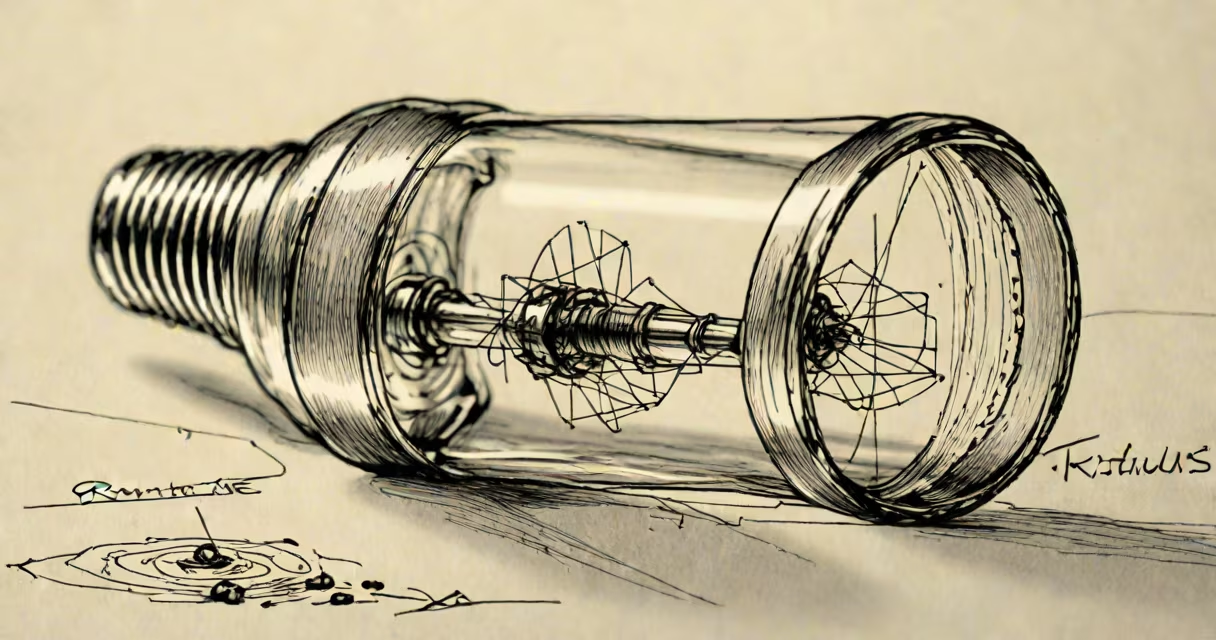
Tritium is a weakly radioactive isotope of hydrogen that emits low-energy beta particles. It decays with a half-life of about 12.3 years and poses negligible external radiation risk due to its very low penetration power.
Tritium's radioactivity stems from nuclear decay in which a neutron transforms into a proton, emitting an electron (beta particle) and an antineutrino. The emitted beta particles have a maximum energy of 18.6 keV-far below the 100 keV threshold needed to penetrate human skin. This means tritium cannot cause external radiation damage under normal conditions.
Despite its low energy, tritium becomes hazardous when ingested or inhaled. Once inside the body, it integrates into water molecules (HTO), distributing throughout bodily fluids. Internal exposure leads to continuous irradiation of tissues, increasing long-term cancer risk. Regulatory limits for tritium in drinking water are set at 740 Bq/L by the U.S. EPA and 10,000 Bq/L by the WHO-levels far below those causing acute harm.
Tritium's beta emissions do not pass through air beyond a few centimeters or through paper. A sheet of paper stops all tritium beta radiation. Even a thin layer of glass or plastic blocks it completely. This makes tritium safe to handle externally when properly contained.
However, when tritium enters the body, it behaves like regular hydrogen. It bonds with oxygen to form tritiated water (HTO), which circulates systemically. Because HTO is chemically identical to H₂O, the body cannot distinguish between them. As a result, tritium distributes uniformly in total body water and remains in the body for about 10 days on average (biological half-life).
Internal exposure results in prolonged low-dose radiation. The effective dose from ingesting 1 Bq of tritium is approximately 1.5 × 10⁻¹⁰ Sv per Bq. For context, a single chest X-ray delivers about 0.1 mSv (100 μSv), while 100 Bq of tritium in the body produces roughly 0.000015 μSv-a fraction of natural background radiation.
Tritium occurs naturally in trace amounts (about 10⁻¹⁸ of all hydrogen atoms) due to cosmic ray interactions in the upper atmosphere. However, most tritium used commercially comes from nuclear reactors, where neutrons bombard lithium-6 to produce tritium.
Common applications include:
These uses require containment. In watches, tritium is sealed in borosilicate glass tubes coated with phosphors. The glass prevents beta particles from escaping. Even if a tube breaks, the risk remains low unless material is swallowed or inhaled.
| Application | Average Activity (per unit) | Risk Level |
|---|---|---|
| Wristwatch vial | ~100 MBq | Very low (sealed) |
| Research reactor | Millions of Bq | High (controlled environment) |
| Environmental release (accidental) | Up to 1 GBq/year | Moderate (monitored) |
Many assume tritium is highly dangerous because it is "radioactive." But radiation strength depends on both activity and biological impact. Tritium ranks among the weakest emitters in the periodic table.
Contrast tritium with iodine-131, which emits gamma rays and concentrates in the thyroid. Iodine-131 can cause tissue damage even at low doses. Tritium lacks gamma emission entirely and does not accumulate in organs-it disperses evenly.
A key distinction: tritium is not alpha or gamma emitter. It only emits beta particles. Alpha radiation is stopped by skin; gamma penetrates deeply. Beta lies in between-but tritium's beta is so weak it cannot breach the outer layer of dead skin cells.
Even in high concentrations, tritium does not cause immediate harm. The U.S. Nuclear Regulatory Commission states that no known cases of radiation sickness resulted from tritium exposure in occupational settings. Long-term risks stem from chronic low-dose exposure, not acute effects.
In 2018, tritium levels were detected in groundwater near a nuclear facility in Ontario, Canada. Concentrations reached 1,200 Bq/L-above the Canadian guideline of 700 Bq/L but still well below the WHO limit of 10,000 Bq/L.
Health authorities assessed the risk using standard models. An adult consuming 2 liters daily of water at 1,200 Bq/L would receive an annual effective dose of about 0.03 mSv. That's less than 1% of average annual background radiation (3 mSv/year).
For comparison, eating one banana exposes a person to about 0.1 μSv from potassium-40. The tritium exposure from drinking water in this case was equivalent to consuming 300 bananas per year.
I once handled a tritium calibration source during a safety training session. The vial was sealed in a lead-lined container. Even with a Geiger counter held directly against the container, the reading remained at background levels. Only when the source was opened in a fume hood did the detector register a rise-proof that containment matters.
After the session, we measured our hands with a survey meter. No elevated readings. Tritium's beta radiation couldn't pass through the skin or the lab coat. The real danger wasn't the radiation-it was contamination. If the vial had broken and liquid spilled on my skin, washing it off immediately prevented absorption.
The International Atomic Energy Agency (IAEA) sets annual intake limits for tritium at 10,000 Bq for adults. The U.S. NRC allows up to 740 Bq/L in drinking water. These values are based on models estimating cancer risk from chronic exposure.
According to the National Council on Radiation Protection and Measurements (NCRP), the lifetime cancer risk from ingesting 1 GBq of tritium is less than 0.001%. That's lower than the risk from smoking or air pollution.
For perspective, a person living near a nuclear power plant receives about 0.1 mSv/year from all sources combined. Tritium releases contribute less than 0.01 mSv/year-even in worst-case scenarios.