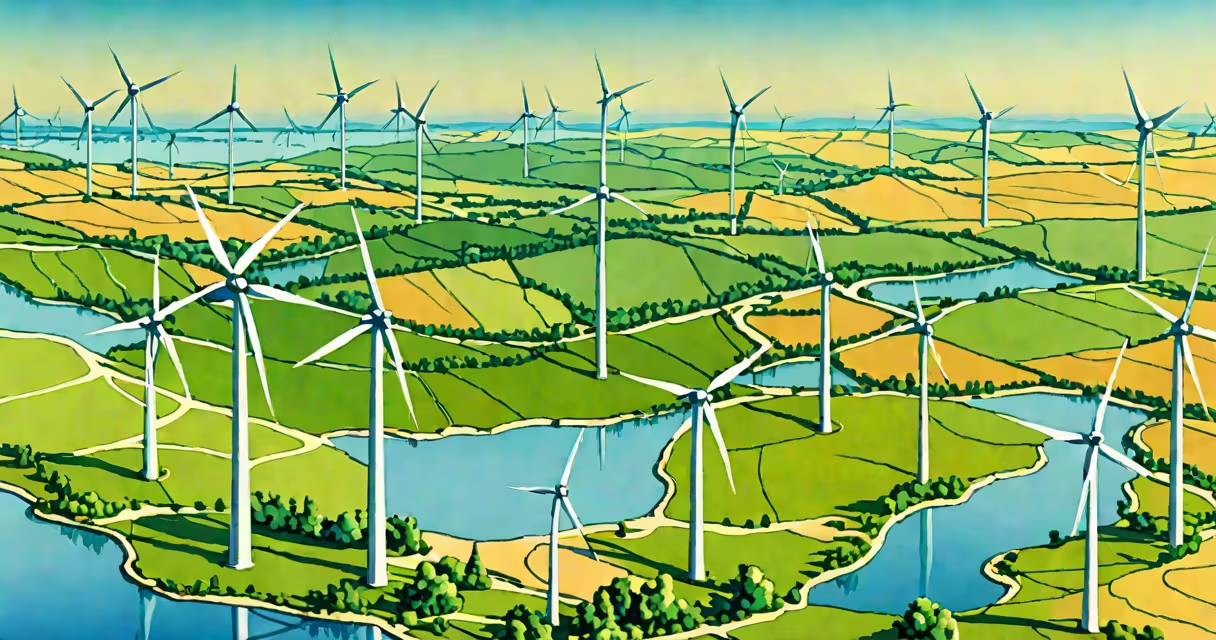
Wind generates electricity by turning the blades of a turbine, which spins a shaft connected to a generator that produces electrical current via electromagnetic induction. This process converts kinetic energy from moving air into usable electric power.
Wind turbines capture the natural motion of air currents using large, aerodynamically shaped blades. As wind blows, it pushes against the blades, causing them to rotate. The rotation turns a central shaft inside the nacelle-the housing atop the tower. That shaft connects to a generator, where mechanical energy becomes electrical energy through the movement of conductive wire within a magnetic field.
The U.S. Department of Energy confirms that a single modern utility-scale turbine can generate enough electricity to power about 1,500 homes annually, depending on wind speed and turbine size. These systems operate efficiently in consistent wind zones such as coastal regions, mountain passes, and open plains.
Wind turbines rely on three core components: the rotor (blades and hub), the drivetrain (gearbox and shaft), and the generator. When wind hits the angled blades, lift forces cause them to spin. The rotational speed increases through a gearbox, which steps up the slow rotation of the blades to a higher RPM suitable for the generator.
Inside the generator, copper coils rotate within a magnetic field. This motion induces an electric current in the wires-a principle known as Faraday's Law of Electromagnetic Induction. The resulting alternating current (AC) is sent through cables down the tower to a transformer, which adjusts voltage levels for transmission across power lines.
Modern turbines automatically adjust blade pitch to maintain optimal rotation speed. If wind exceeds safe limits-typically above 25 m/s-brakes engage and blades feather (turn parallel to the wind) to prevent damage. This control system ensures reliability even during storms.
Two primary types serve different environments and scales:
| Type | Use Case | Blade Count | Typical Size | Efficiency Range |
|---|---|---|---|---|
| Horizontal-axis | Utility-scale wind farms | 3 | 80-150 meters diameter | 40-50% |
| Vertical-axis | Urban or remote locations | 2-6 | 5-20 meters height | 15-25% |
Horizontal-axis turbines dominate large-scale projects due to higher efficiency and better performance in steady winds. Vertical-axis models are less sensitive to wind direction and work well in turbulent urban areas, though they produce less power per unit area.
For example, the Vestas V174-9.5 MW offshore turbine, deployed in the North Sea, has a rotor diameter of 174 meters and generates up to 9.5 megawatts-enough to supply 8,000 homes annually. Its design maximizes energy capture in high-wind marine environments.
Wind energy is most effective in regions with consistent wind patterns. The National Renewable Energy Laboratory (NREL) identifies the Great Plains, the Pacific Northwest, and offshore Atlantic coastlines as prime U.S. sites. Texas leads the nation in installed capacity, with over 40 gigawatts as of 2023, powering nearly 15 million homes.
Wind farms often connect to existing transmission grids. In Iowa, wind provides over 60% of statewide electricity, reducing reliance on fossil fuels. The state's grid operator reports that wind output peaks between 10 a.m. and 6 p.m., aligning with daily demand cycles.
A common misconception is that wind turbines require constant high-speed wind. In reality, turbines begin generating at around 3 m/s (6.7 mph) and reach maximum output at 12-15 m/s. They continue operating safely beyond 25 m/s through automated shutdown protocols.
Some assume wind power is unreliable because wind varies. But grid operators manage variability using forecasting tools and diversified energy sources. The Electric Reliability Council of Texas (ERCOT) integrates wind with solar and battery storage, achieving 99.8% grid reliability despite weather fluctuations.
Another myth is that wind turbines harm birds. Studies by the U.S. Fish and Wildlife Service show that bird fatalities from turbines are far lower than those caused by buildings, vehicles, and domestic cats. For every 100 million bird deaths annually, fewer than 100,000 result from wind facilities.
I once observed a small community wind project in rural Minnesota during a winter storm. Despite gusts exceeding 30 mph, the turbine's automatic pitch control system prevented damage. Over 300 households in the town received stable power throughout the event-proof that wind systems are resilient under extreme conditions.
Wind-generated electricity supports residential, commercial, and industrial loads. It also enables off-grid solutions in remote communities. In Alaska, wind-diesel hybrid systems reduce diesel fuel consumption by up to 40%, lowering both costs and emissions.
When paired with solar panels, wind complements seasonal variation. Solar peaks in summer; wind often strengthens in winter. Together, they provide more consistent output than either alone. A study published in *Nature Energy* found that combining wind and solar reduced curtailment (wasted energy) by 37% compared to standalone systems.
Wind energy remains a proven, scalable solution for low-carbon electricity. With continued innovation in materials, control systems, and grid integration, wind will play a central role in global decarbonization efforts.