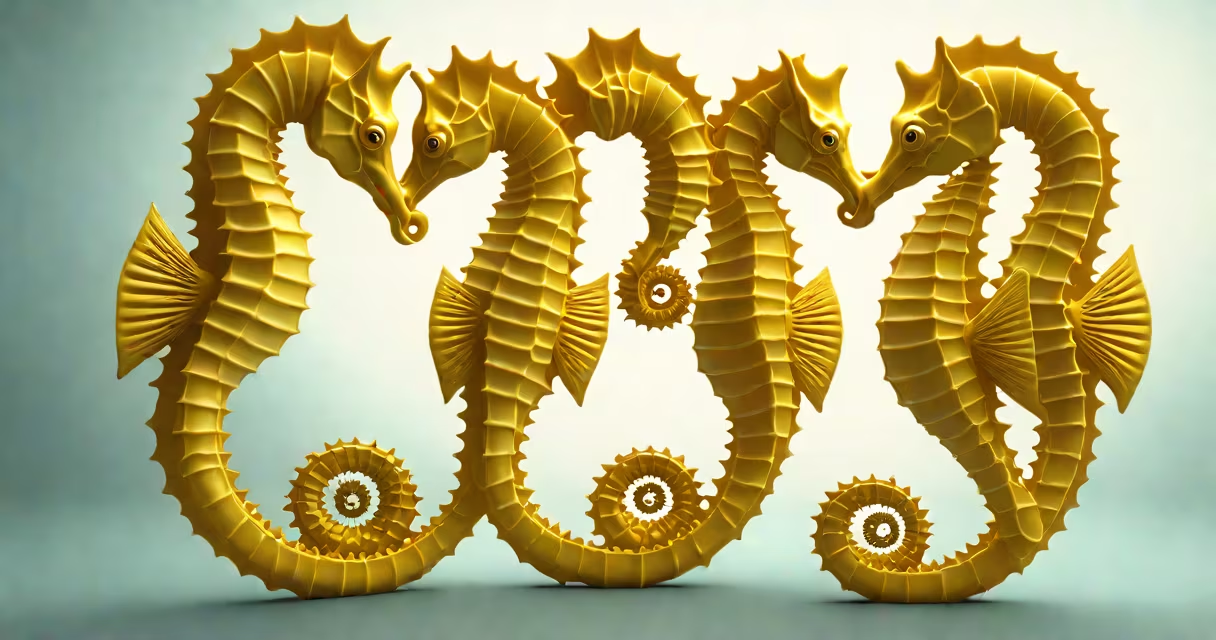
Seahorses reproduce through internal fertilization, with males carrying and giving birth to live young in a specialized brood pouch. This makes them one of the few animal species where males undergo pregnancy.
Reproduction begins with a courtship ritual lasting several days. The pair swims together, often changing colors and performing synchronized movements. During this time, they align their bodies and transfer eggs from the female to the male's brood pouch via a specialized ovipositor. The male then fertilizes the eggs internally. The brood pouch provides oxygen, nutrients, and waste regulation for developing embryos-functioning much like a mammalian uterus.
After 2 to 4 weeks, depending on species and water temperature, the male gives birth to hundreds of tiny, fully formed seahorse fry. Birth occurs through muscular contractions, expelling the young into the water column. The female may lay multiple batches of eggs per breeding season, while the male prepares his pouch for the next cycle.
Female seahorses produce eggs in clusters, typically ranging from 50 to 1,000 per spawn. These eggs are transferred to the male's brood pouch during a brief, precise alignment. The pouch opens slightly, and the female deposits her eggs into the cavity. The male then releases sperm to fertilize them internally.
The brood pouch is lined with blood vessels that supply oxygen and nutrients to the embryos. As development progresses, the male regulates osmotic balance and removes metabolic waste. The environment inside the pouch remains stable, mimicking conditions found in placental mammals-but without a true placenta.
Once the fry are ready, the male contracts muscles around the pouch, forcing the young out through a small opening. Each birth event can release between 50 and 1,000 offspring. Newborns are independent immediately and must fend for themselves in the wild.
While all seahorses share the core reproductive strategy, differences exist among species in egg count, gestation duration, and mating frequency.
| Species | Avg. Egg Count per Spawn | Gestation Period | Breeding Frequency |
|---|---|---|---|
| Common seahorse (Hippocampus hippocampus) | 100-200 | 18-25 days | Every 2-3 weeks |
| Longsnout seahorse (Hippocampus reidi) | 200-500 | 20-30 days | Every 3-4 weeks |
| Big-belly seahorse (Hippocampus abdominalis) | 500-1,000 | 25-35 days | Every 4-6 weeks |
These values reflect data collected from controlled aquarium settings and field observations. Water temperature affects gestation length-warmer waters accelerate development.
Reproduction occurs in shallow coastal habitats, including seagrass beds, coral reefs, and mangrove roots. These environments offer cover from predators and abundant food for adults and juveniles.
Male pregnancy evolved as a way to increase offspring survival. By protecting embryos in a closed, regulated space, the male ensures higher rates of successful development compared to external spawning. This adaptation likely arose due to high predation pressure on free-floating eggs and larvae in marine ecosystems.
According to the Nature Ecology & Evolution study (2022), the evolution of male pregnancy in syngnathids (the family including seahorses, pipefish, and seadragons) is linked to increased parental investment and reduced juvenile mortality. The study notes that species with larger brood pouches tend to have lower offspring survival rates when left unattended.
Many assume seahorses mate for life. While some pairs form long-term bonds, especially in stable environments, this is not universal. Studies show that seahorses may switch partners between breeding cycles, particularly in crowded or resource-limited areas.
Another misconception is that the male "gives birth" in the same way mammals do. Unlike humans, seahorses do not experience labor pain or contractions that last hours. Birth events take minutes and involve rhythmic muscle pulses. The young emerge fully formed and capable of swimming within seconds.
Some believe seahorses are monogamous throughout their lives. Data from long-term tracking in the Mediterranean shows that while 60% of pairs remain together for at least one breeding season, 40% split and remate. Monogamy appears context-dependent, influenced by habitat stability and population density.
In a controlled setting at the Seahorse Conservation Project, a pair of common seahorses (Hippocampus hippocampus) was observed over a 6-week period. On Day 1, the female began displaying courtship behaviors-color changes and tail entwining. Over the next 3 days, they performed synchronized dances.
On Day 4, the female transferred 150 eggs into the male's brood pouch. The male sealed the pouch and began regulating internal conditions. After 22 days, he began contracting his body every 10 minutes. On Day 26, he expelled 138 healthy fry. All survived past the first week under controlled feeding.
This case demonstrates the precision of timing and physiology involved. The male's ability to regulate pH, oxygen levels, and fluid balance during gestation is critical. Even minor deviations in water quality led to embryo loss in experimental trials.
Understanding how seahorses reproduce informs conservation efforts. Overfishing, habitat destruction, and climate change threaten seahorse populations worldwide. The International Union for Conservation of Nature (IUCN) lists nine of the 54 known species as endangered.
Because seahorses have low reproductive output relative to other fish-fewer than 100 offspring per year on average-they cannot recover quickly from population declines. Their reliance on specific habitats and complex mating rituals makes them vulnerable to environmental disruption.
Conservation programs now focus on breeding in captivity to support reintroduction. Facilities like the Oceana Marine Research Center use artificial brood pouches and hormone triggers to mimic natural conditions, improving success rates in captive breeding.
Male pregnancy in seahorses is not just a biological curiosity-it's a key to understanding evolutionary trade-offs in parental care. The shift from external to internal development represents a major adaptation in a group of fish otherwise known for minimal parental involvement.
How do seahorses reproduce? Through a rare system where males carry and give birth to live young. This process involves courtship, internal fertilization, and extended embryonic development in a protective pouch-making seahorses one of nature's most notable reproductive experiments.