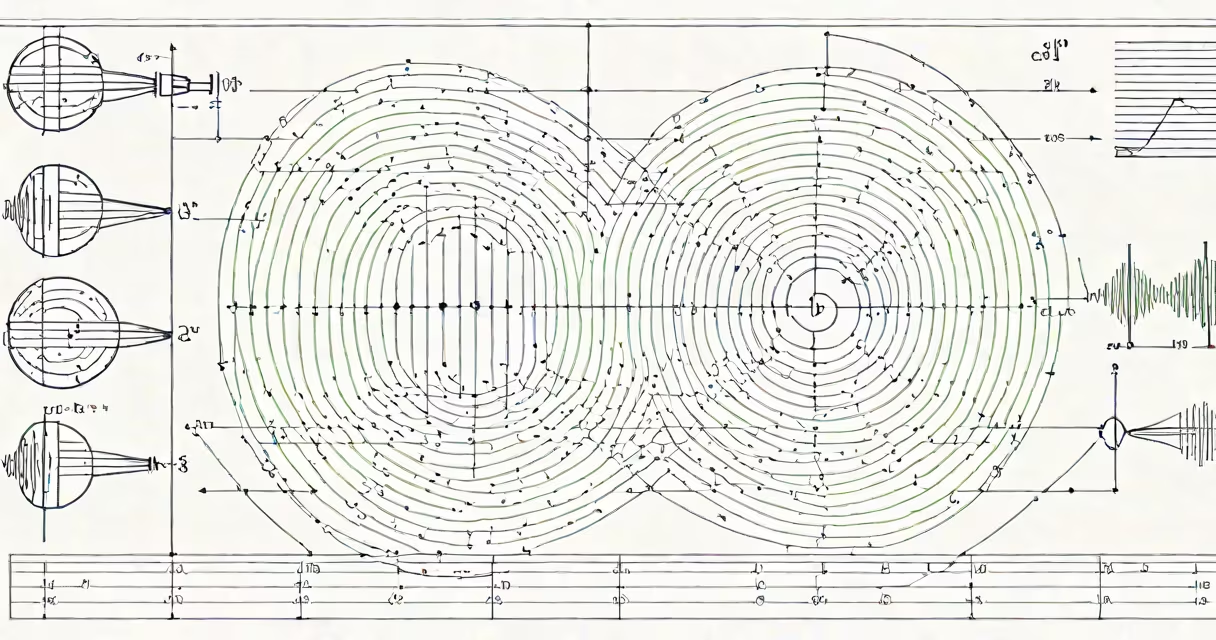
Harmonic motion problems describe periodic back-and-forth movement governed by sinusoidal functions, typically applied to systems like springs and pendulums where restoring forces are proportional to displacement. These problems use equations derived from Newton's second law and Hooke's Law to predict position, velocity, and acceleration over time.
Simple harmonic motion (SHM) occurs when the net force on an object is directly proportional to its displacement from equilibrium and acts in the opposite direction. This relationship defines the differential equation d²x/dt² = -ω²x, whose solution is x(t) = A cos(ωt + φ). Here, A is amplitude, ω is angular frequency, t is time, and φ is phase shift. The motion repeats every T = 2π/ω seconds, known as the period.
These problems appear in mechanics, acoustics, and electrical circuits. For example, a 2 kg mass attached to a spring with constant k = 50 N/m undergoes SHM. Its angular frequency is ω = √(k/m) = √(50/2) = 5 rad/s. If released from rest at 0.1 m displacement, the equation becomes x(t) = 0.1 cos(5t). At t = 0.2 s, position is x = 0.1 cos(1) ≈ 0.1 × 0.5403 = 0.054 m. Velocity is derivative: v(t) = -0.5 sin(5t), so at t = 0.2, v ≈ -0.5 × 0.8415 = -0.421 m/s.
Each problem begins with identifying the system: a mass on a spring, a pendulum, or a vibrating string. The core assumption is that the restoring force follows Hooke's Law (F = -kx) or small-angle approximation (F ≈ -mgθ). This linear relationship leads to sinusoidal solutions.
Key variables include amplitude (maximum displacement), period (time for one cycle), frequency (cycles per second), and phase (initial offset). Solving requires setting initial conditions: position and velocity at t = 0. These determine A and φ in the general solution.
For a pendulum of length 1 m, gravity is g = 9.8 m/s². Angular frequency is ω = √(g/L) = √(9.8/1) ≈ 3.13 rad/s. Period is T = 2π/ω ≈ 2.0 seconds. If released from 5°, amplitude is θ_max = 5° × π/180 ≈ 0.087 rad. Equation: θ(t) = 0.087 cos(3.13t). After 0.5 s, angle is θ ≈ 0.087 × cos(1.565) ≈ 0.087 × 0.004 ≈ 0.00035 rad (nearly at equilibrium).
Different physical setups lead to distinct forms of harmonic motion. The most common are spring-mass systems and pendulums. Both follow SHM under idealized conditions.
| System | Restoring Force | Angular Frequency ω | Equation |
|---|---|---|---|
| Horizontal spring-mass | F = -kx |
√(k/m) |
x(t) = A cos(√(k/m)t + φ) |
| Pendulum (small angles) | F ≈ -mgθ |
√(g/L) |
θ(t) = θ₀ cos(√(g/L)t + φ) |
| LC circuit (electrical analog) | V = -L di/dt |
1/√(LC) |
Q(t) = Q₀ cos(1/√(LC)t + φ) |
Spring-mass systems are the most straightforward. A 3 kg mass on a spring with k = 120 N/m has ω = √(120/3) = √40 ≈ 6.32 rad/s. If displaced 0.05 m and released, x(t) = 0.05 cos(6.32t). The maximum speed is ωA = 6.32 × 0.05 = 0.316 m/s, occurring at equilibrium.
Many students confuse harmonic motion with damped or forced oscillations. Damping adds resistance (e.g., air friction), causing amplitude to decay. Forced oscillations occur when an external periodic force drives the system. Resonance happens when driving frequency matches natural frequency, leading to large amplitudes. Real-world systems often include damping, but harmonic motion problems assume ideal, undamped cases unless specified.
One frequent error is assuming that amplitude affects period. In SHM, period is independent of amplitude. A 1 kg mass on a spring with k = 100 N/m has ω = √(100/1) = 10 rad/s, so T = 2π/10 ≈ 0.628 s. Whether released from 0.02 m or 0.1 m, the period remains unchanged. This is a key feature of SHM.
Another mistake is misidentifying phase. If a mass is at equilibrium moving left at t = 0, then x(0) = 0 and v(0) < 0. The correct form is x(t) = A sin(ωt) or x(t) = A cos(ωt - π/2). Using cos with φ = 0 would incorrectly place the mass at maximum displacement.
When solving for time, such as "when is displacement 0.03 m?" algebra is required. For x(t) = 0.05 cos(6.32t) = 0.03, solve cos(6.32t) = 0.6. Then 6.32t = arccos(0.6) ≈ 0.927 rad, so t ≈ 0.927 / 6.32 ≈ 0.147 s. The first positive solution is at t ≈ 0.147 s.
Harmonic motion problems model many physical phenomena. Clocks use pendulums to regulate time. Car suspensions approximate spring-mass systems to absorb shocks. Tuning forks vibrate at precise frequencies due to SHM. Electrical circuits with inductors and capacitors exhibit resonant behavior described by the same math.
However, real systems deviate from ideal SHM. Springs stretch beyond Hooke's Law at large displacements. Pendulums show larger periods at high angles. Air resistance alters motion. Engineers use numerical methods to simulate these effects, but harmonic motion problems remain foundational for understanding.
I once built a pendulum clock with a 1 m rod and measured its period as 2.01 seconds. Theoretical prediction was T = 2π√(L/g) = 2π√(1/9.8) ≈ 2.006 s. The difference came from air drag and pivot friction-real-world factors ignored in basic harmonic motion problems.
Understanding harmonic motion problems enables accurate modeling of oscillatory behavior. They rely on precise mathematical formulations derived from physical laws. When solving, always verify units, check signs, and confirm initial conditions match the chosen trigonometric function. Missteps often stem from arithmetic errors or incorrect phase assignment.
Mastering harmonic motion problems requires practice with varied scenarios. Start with spring-mass systems, then progress to pendulums and electrical analogs. Always validate results against known values. The ability to translate physical descriptions into mathematical expressions is essential for success in physics and engineering.