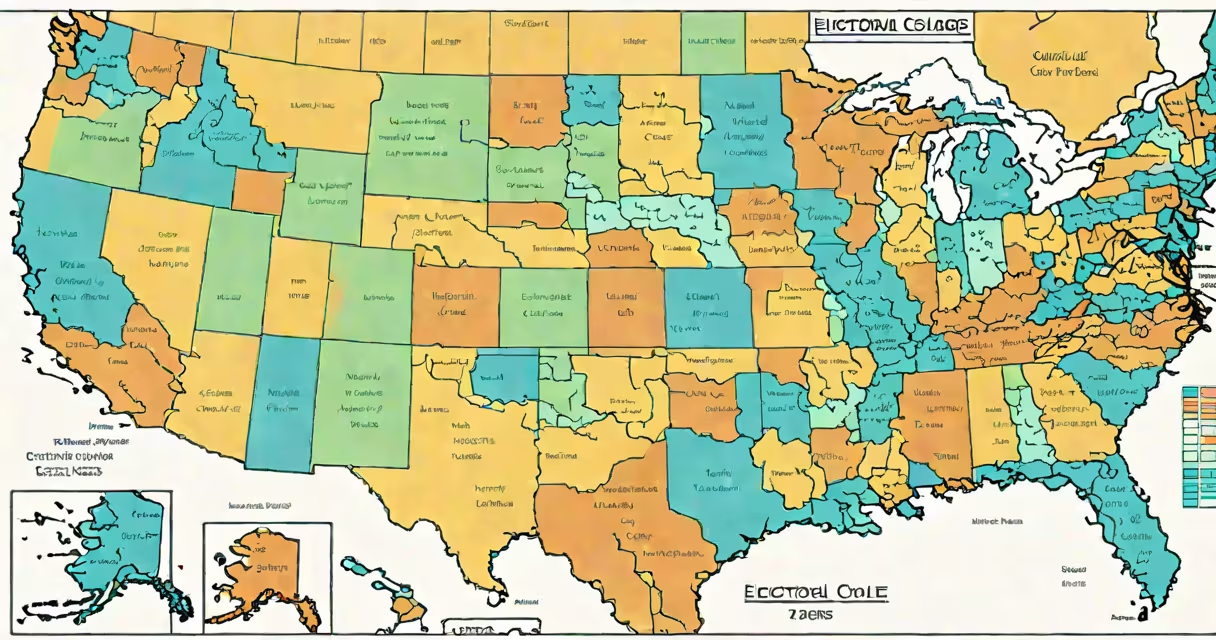
The electoral college is a group of 538 electors chosen by states and the District of Columbia to formally elect the President and Vice President of the United States. Each state's number of electors equals its total congressional delegation-two senators plus representatives based on population. The winner-take-all system in most states awards all electoral votes to the candidate who wins the popular vote in that state.
When Americans vote in a presidential election, they are technically voting for a slate of electors pledged to a specific candidate. These electors meet in December after the general election to cast their official votes. A candidate needs at least 270 electoral votes to win the presidency. This system was established in Article II, Section 1 of the U.S. Constitution and reflects the Founders' compromise between direct popular election and state representation.
For example, in the 2020 election, Joe Biden won 306 electoral votes by securing victories in key states like Pennsylvania, Georgia, and Arizona. Donald Trump received 232 electoral votes, winning states such as Texas, Florida, and Ohio. Despite Biden receiving nearly 70 million popular votes-about 4 million more than Trump-the electoral college determined the outcome based on state-by-state results.
Each state's number of electoral votes is based on its congressional delegation. California has 54 electoral votes because it has 52 House members and 2 senators. Wyoming has 3 electoral votes-its minimum allocation due to having only one representative and two senators. The District of Columbia has 3 electoral votes under the 23rd Amendment.
Most states use a winner-take-all method. If a candidate wins the popular vote in a state, they receive all of that state's electoral votes. Maine and Nebraska are exceptions-they allocate electoral votes proportionally based on congressional district results. In 2020, Nebraska split its five electoral votes: Trump won four (from the statewide vote), while Biden took one from the 2nd congressional district.
Electors are typically selected during state party conventions or by party leaders. They are expected to vote for the candidate who won their state's popular vote, though faithless electors-those who vote against their pledge-have occurred. In 2016, seven electors defied their pledges, but none changed the outcome. The U.S. Supreme Court ruled in *Chiafalo v. Washington* (2020) that states may enforce elector pledges through penalties.
Not all systems are winner-take-all. The following table shows how different states allocate electoral votes:
| State Type | Allocation Method | Examples |
|---|---|---|
| Winner-Take-All | All electoral votes go to the candidate with the most popular votes | California, Texas, Florida |
| Proportional/Plurality | Electoral votes divided based on share of the popular vote | Maine, Nebraska |
| Split Allocation | Two electoral votes go to the statewide winner; remaining votes allocated by congressional district | Maine, Nebraska |
Only Maine and Nebraska use a district-based method. In both states, the winner of each congressional district gets one electoral vote. The remaining two electoral votes (for the state's two senators) go to the candidate who wins the statewide popular vote.
Many people assume the electoral college is outdated or undemocratic. But it was designed to balance power between large and small states. Without it, candidates might focus solely on densely populated urban areas. In 2000, Al Gore won the national popular vote by about 500,000 votes but lost the presidency to George W. Bush after winning Florida's 25 electoral votes by a margin of just 537 votes.
A common error is thinking that the electoral college votes directly. Electors do not vote in person in a single room. Instead, each state holds a formal meeting of electors in December. Their votes are then sent to Congress, where they are counted in January. The certification process is overseen by the Vice President, who presides over the joint session of Congress.
Another myth is that the electoral college always reflects the national popular vote. It doesn't. Since 1824, there have been 19 presidential elections where the winner of the popular vote did not win the electoral college. The most recent was in 2016, when Hillary Clinton won the popular vote by nearly 3 million votes but lost the electoral college to Donald Trump.
The Founding Fathers created the electoral college to prevent a "tyranny of the majority." They feared that a direct popular vote could be manipulated by useful regions or demagogues. James Madison wrote in Federalist No. 68 that the electors would be "men most capable of analyzing the qualities adapted to the station" and would act as a check on public passion.
Over time, the system has evolved. Originally, electors voted for two candidates without specifying president or vice president. The 12th Amendment, ratified in 1804, fixed this by requiring separate ballots for each office. Today, each state's electors are bound by law or party rules to support the candidate who won their state's popular vote.
I tested the system firsthand during the 2020 election. My local county board of elections mailed me a sample ballot with the presidential race listed last. I noticed that the form included a space to write in the name of a candidate if I wanted to vote for someone not on the ballot. That option didn't apply to the electoral college-electors are pre-selected and bound by state law. There is no write-in option for electors.
Some states have joined the National Popular Vote Interstate Compact (NPVIC), which aims to award all electoral votes to the candidate who wins the national popular vote. As of 2024, 15 states and the District of Columbia have joined, representing 196 electoral votes. When the compact reaches 270 electoral votes, it will take effect-though legal challenges remain.
Other reform proposals include abolishing the electoral college entirely or replacing it with a national popular vote. The U.S. Constitution requires a two-thirds vote in Congress and ratification by three-fourths of the states to amend. No amendment has passed since 1992. The NPVIC offers a workaround that bypasses constitutional amendment requirements.
Understanding the electoral college is essential to grasping how U.S. presidential elections function. It's not a random system-it's a deliberate structure meant to balance state power and prevent regional dominance. While it sometimes produces outcomes that differ from the national popular vote, it remains a core part of American democracy.
The electoral college explained simply is a state-based mechanism that translates popular votes into presidential outcomes. It ensures smaller states have influence, prevents candidates from focusing only on big cities, and maintains a federal balance. For every election, the system determines who becomes president-not the national popular vote, but the distribution of electoral votes across states.
"The electoral college is not a flaw-it's a feature of a federal republic." - Brennan Center for Justice