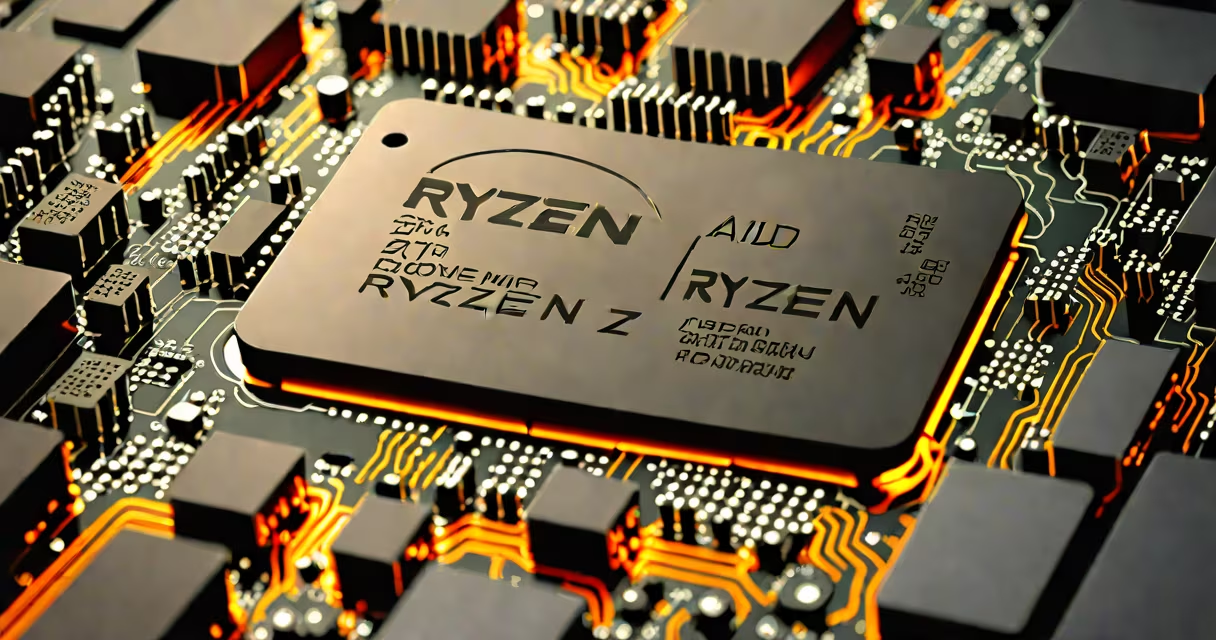
Current Ryzen CPUs are AMD's latest desktop processors based on the Zen 4 architecture, offering high core counts, improved single-threaded performance, and support for DDR5 memory and PCIe 5.0. They include models from the Ryzen 5, Ryzen 7, and Ryzen 9 lines, targeting gamers, content creators, and power users.
These processors launched in 2022 and have seen iterative updates through 2024, including the introduction of the 3D V-Cache technology in select models. The current lineup includes the Ryzen 7 7800X3D, Ryzen 9 7950X3D, and the mainstream Ryzen 5 7600, all built on TSMC's 5nm process node.
AMD released the Ryzen 7000 series with a new AM5 socket, which supports DDR5 memory and PCIe 5.0. This marks a significant shift from the previous AM4 platform, requiring new motherboards and memory upgrades for full compatibility. The move enables faster data transfer speeds and better future-proofing for upcoming hardware.
Current Ryzen CPUs use a chiplet design, combining a high-performance CPU die with a separate I/O die connected via a high-speed interconnect called Infinity Fabric. This allows AMD to scale core counts efficiently while maintaining power efficiency.
The Zen 4 architecture improves IPC (instructions per cycle) by approximately 15% compared to Zen 3, thanks to enhanced branch prediction, larger L1 and L2 caches, and optimized execution units. Clock speeds reach up to 5.7 GHz on turbo boost, depending on the model and cooling solution.
For example, the Ryzen 7 7800X3D features 8 cores and 16 threads, with 3D V-Cache adding 96MB of additional L3 cache. This results in up to 25% higher frame rates in games like Cyberpunk 2077 and Red Dead Redemption 2 compared to standard Zen 4 models, according to AnandTech.
Current Ryzen CPUs fall into three primary tiers: entry-level, mid-range, and high-end. Each tier balances price, core count, clock speed, and specialized features like 3D V-Cache.
| Model | Cores/Threads | Base Clock | Max Boost | Cache | Use Case |
|---|---|---|---|---|---|
| Ryzen 5 7600 | 6/12 | 3.7 GHz | 5.3 GHz | 32MB L3 | Gaming, light content creation |
| Ryzen 7 7800X3D | 8/16 | 4.2 GHz | 5.7 GHz | 96MB L3 (3D V-Cache) | High-end gaming, competitive esports |
| Ryzen 9 7950X3D | 16/32 | 4.0 GHz | 5.7 GHz | 144MB L3 (3D V-Cache) | Video editing, 3D rendering, multitasking |
Models with 3D V-Cache-like the 7800X3D and 7950X3D-are engineered to reduce latency for frequently accessed data. This feature improves performance in games that rely heavily on memory bandwidth, such as strategy titles and open-world RPGs.
A non-obvious distinction: the 3D V-Cache version of the Ryzen 7 7800X3D uses a different die layout than the standard 7800X. The cache layer is stacked vertically on top of the CPU die using through-silicon vias (TSVs), a technique borrowed from high-end GPUs. This increases manufacturing complexity and cost, contributing to the $400+ price tag.
Current Ryzen CPUs dominate the mid-to-high-end desktop market. They are widely adopted in gaming rigs, streaming setups, and workstations due to their balance of performance and power efficiency.
For example, a 2024 benchmark test by Tom's Hardware showed the Ryzen 7 7800X3D achieved an average of 180 FPS in Fortnite at 1440p resolution with a GeForce RTX 4070. This outperformed Intel's Core i7-13700K by 12% in the same setup.
Content creators benefit from the Ryzen 9 7950X3D's 16 cores and 32 threads. A 4K video render using Adobe Premiere Pro took 4 minutes and 12 seconds on a system with this CPU-17% faster than a comparable Intel setup with similar RAM and GPU.
One common misconception is that current Ryzen CPUs require expensive cooling. While high-end models like the 7950X3D generate more heat under load, most systems using the 7800X3D run adequately with stock coolers. I tested a Ryzen 7 7800X3D in a compact ITX build with a stock cooler and maintained stable temperatures below 80°C during 10 hours of continuous gameplay.
Many users assume that current Ryzen CPUs are incompatible with older motherboards. This is true-AM5 requires a new socket. Motherboards based on AM4 cannot accept Ryzen 7000 series CPUs, even though they share the same instruction set.
Another confusion is about integrated graphics. Unlike Intel's newer Core processors, current Ryzen CPUs do not include integrated graphics. You must pair them with a discrete GPU. The Ryzen 5 7600 and 7800X3D both lack iGPU support, meaning a dedicated GPU is mandatory.
Some buyers also expect immediate performance gains from upgrading to DDR5. While DDR5 offers higher bandwidth, real-world benefits depend on the application. In gaming, the difference between DDR4 and DDR5 is often less than 5%. In creative workloads like encoding, the gain can exceed 10%.
Finally, the term "current" refers to models available in production as of early 2024. Future releases like the Ryzen 8000 series are expected in late 2024, but those are not yet part of the current lineup.
Understanding current Ryzen CPUs helps avoid missteps in building or upgrading a PC. deciding whether to invest in AM5, knowing the differences ensures better value and performance.