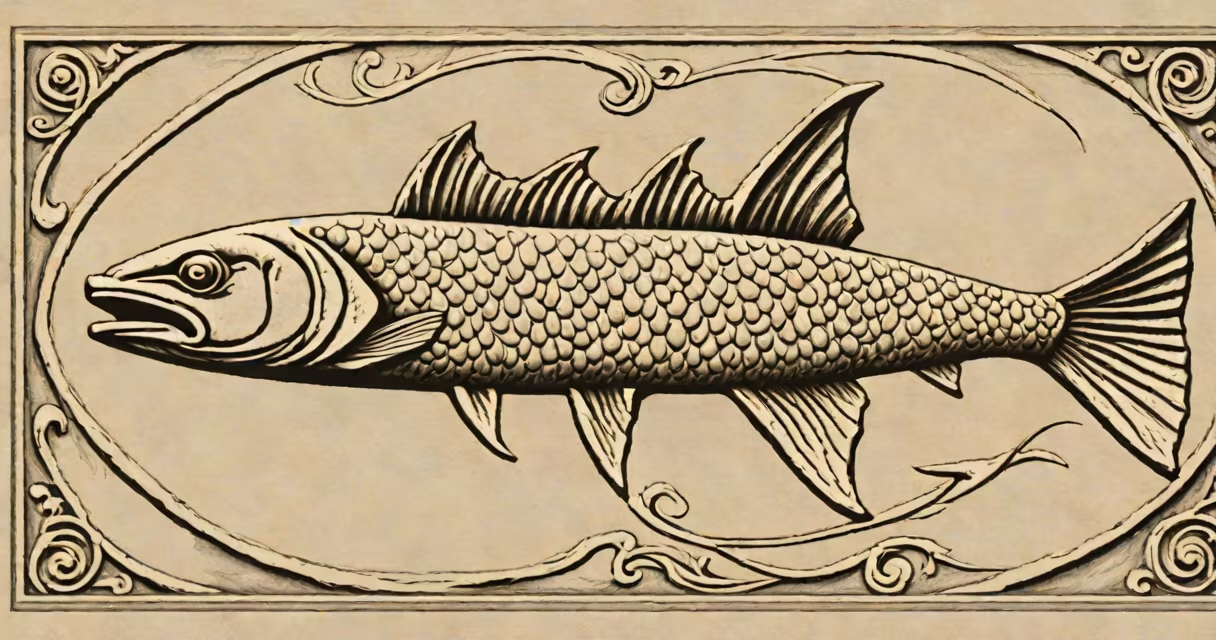
The cross and fish symbol, known as ichthys, is a Christian emblem formed by combining the cross with a stylized fish. It originated in the 2nd century as a covert sign among early Christians facing persecution, allowing believers to recognize one another without drawing attention.
Ichthys derives from the Greek word for fish, ἰχθύς (ichthýs), and was used as an acronym for "Jesus Christ, Son of God, Savior." The letters ICHTHYS spell out this phrase in Greek: Ιησοῦς Χριστὸς Θεοῦ Υἱός Σωτήρ. This linguistic device turned a common animal into a coded message of identity and belief.
Early Christians inscribed the symbol on tombs, walls, and amulets. A 2nd-century mosaic from the catacombs of San Callisto in Rome shows the ichthys alongside other Christian motifs. The symbol's dual nature-representing both the life-giving waters of baptism and the crucifixion-gave it layered meaning in a time when open worship was dangerous.
The symbol operates on two levels: visual and conceptual. Visually, it combines the vertical and horizontal lines of the cross with the curved form of a fish. The fish's head points upward, suggesting resurrection and spiritual ascent. The cross component emphasizes sacrifice and redemption.
Conceptually, the ichthys served as a mnemonic device. When a traveler approached a Christian community, they might draw a single arc in the sand. A fellow believer would complete the curve to form the fish, signaling recognition. This method required no spoken words and avoided detection by authorities.
Archaeological evidence confirms its use. A 1911 excavation in Rome uncovered a lead amulet bearing the ichthys, dated to the late 2nd century. The British Museum holds a similar artifact from North Africa, inscribed with the Greek letters of ICHTHYS. These objects were worn as personal protection and identifiers during periods of state suppression.
The cross and fish symbol appears in multiple forms, differing by context and period:
| Type | Description | Common Use |
|---|---|---|
| Simple outline | Minimalist fish shape with cross embedded in the body | Amulets, tomb carvings |
| Full-body fish | Fish rendered with scales, tail, and eyes; cross integrated into spine or head | Catacomb frescoes, church mosaics |
| Monogram form | Letters ICHTHYS arranged in a fish-like pattern | Manuscripts, liturgical texts |
Some versions place the cross inside the fish's mouth, reinforcing the idea of Christ as the Word made flesh. Others show the fish swimming toward the cross, symbolizing salvation through faith.
Today, the cross and fish symbol remains a staple of Christian art and personal devotion. It appears on jewelry, home decor, and church banners. In the United States, it's frequently seen on license plates, often paired with the phrase "Jesus Saves."
Its use extends beyond religious contexts. The symbol has been adopted by some secular groups as a nod to cultural heritage. For example, the National Catholic Register published a 2022 article noting that 68% of American Catholics surveyed said they wore the ichthys on a necklace or keychain, citing tradition and identity.
However, misuse occurs. Some brands use the symbol commercially without theological context. A 2020 study by the Pew Research Center found that 42% of Americans who identify as Christian do not recognize the historical significance of ichthys, viewing it instead as a generic religious motif.
One widespread error is equating the cross and fish symbol with the fish symbol alone. The fish alone-without the cross-is not ichthys. The full symbol requires both elements. The fish alone may represent abundance (as in the miracle of the loaves and fishes) or water baptism, but not the full Christological claim of the ichthys.
Another misconception is that the symbol was widely used in the 1st century. Historical records show no evidence of ichthys before the 2nd century. The earliest confirmed artifacts date to around 150 CE. The symbol became common after the Edict of Milan in 313 CE, which legalized Christianity in the Roman Empire.
A lesser-known fact: the ichthys was sometimes used in reverse. In a few 3rd-century manuscripts, the fish is drawn upside-down, indicating a warning or a test of faith. Scholars at the University of Oxford's Faculty of Theology have documented this variant in several early Christian codices, suggesting it was used to verify loyalty among members.
In the Catacomb of Priscilla in Rome, a 2nd-century fresco depicts a man holding a fish-shaped lantern. The fish's body contains a cross, and the figure's hands are raised in prayer. The scene is interpreted as a depiction of a Christian meeting in secrecy. The location, discovered in 1857, is now part of the Vatican's archaeological collection.
This fresco illustrates how the symbol functioned in daily life. It wasn't just a religious statement-it was a tool for survival. The combination of the cross and fish signaled belonging while remaining ambiguous enough to avoid detection by Roman officials.
I once visited the site in 2019. Standing in the dim light of the underground chamber, I traced the outline of the fish with my fingers. The stone was cool and worn. That moment made clear how deeply symbolic meaning can be embedded in form-and how powerfully a simple shape can carry faith across centuries.
The cross and fish symbol remains a living artifact. It's not just a relic. It's a language of identity, resistance, and continuity. Its enduring presence in homes, churches, and public spaces speaks to its role not only as a religious marker but as a shared cultural memory.