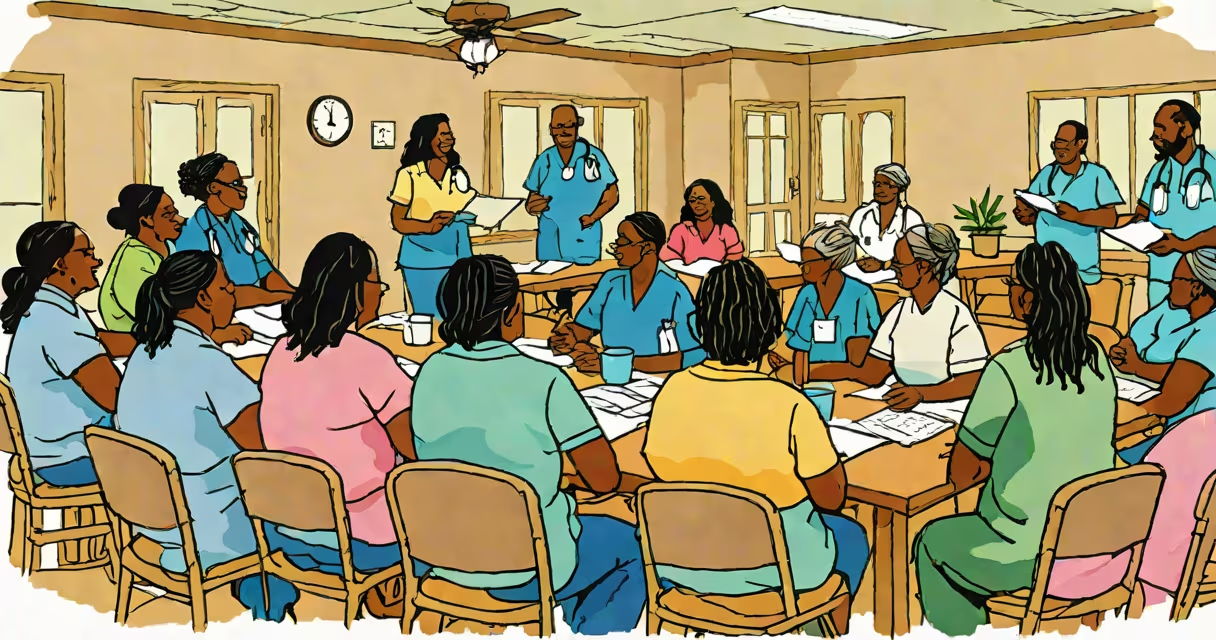
community health partnerships are coordinated efforts between healthcare organizations, community groups, and public agencies to address local health challenges by aligning resources, expertise, and community input. These collaborations focus on reducing health inequities and improving outcomes through prevention, outreach, and culturally responsive services.
They function by bringing together stakeholders who bring different strengths-clinics provide medical access, nonprofits offer outreach and trust-building, and community members share lived experience. This model shifts from treating illness to preventing it, especially in neighborhoods with limited access to care.
For example, in San Diego's City Heights neighborhood, a coalition including Sharp Healthcare, the San Diego County Health Department, and local faith-based groups launched a diabetes prevention program. They offered free screenings, cooking classes, and transportation to clinics. Over two years, participants reduced A1C levels by an average of 1.2 points-a clinically significant improvement.
These partnerships operate through structured planning cycles. They begin with needs assessments using local data-like hospitalization rates, vaccination coverage, or food insecurity maps-to identify priority issues. Then, stakeholders co-design interventions based on evidence and community feedback.
Implementation relies on shared governance. Decisions aren't made top-down. Instead, rotating leadership roles ensure that community voices shape timelines, messaging, and evaluation methods. For instance, a partnership in rural Appalachia included a former school bus driver as a lead navigator because he knew which families were most likely to miss appointments.
Monitoring happens through regular data reviews. Metrics like emergency department visits, patient satisfaction scores, and chronic disease control rates are tracked quarterly. When outcomes don't meet targets, teams adjust strategies-such as shifting from clinic-based to home-based visits during flu season.
Partnerships vary by scale, funding source, and geographic focus. The most effective ones are anchored in long-term commitments, often supported by federal grants or state health departments.
| Type | Scope | Funding Source | Example |
|---|---|---|---|
| Local Health Coalition | Neighborhood or city-wide | State Medicaid funds, local health authority | San Diego's Community Health Group, which coordinates 47 partner organizations across 12 ZIP codes |
| Regional Prevention Network | Multiple counties | CDC grant, HRSA funding | Northwest Washington Prevention Partnership, serving 12 counties with mental health and substance use programs |
| Specialized Care Alliance | Condition-specific | NIH research funding, private foundation | Urban Maternal Health Collaborative in Detroit, focused on reducing Black maternal mortality |
Some partnerships form around specific health goals. The National Association of County and City Health Officials (NACCHO) reports that 68% of successful community health partnerships prioritize addressing social determinants of health-like housing instability or lack of healthy food options-as much as clinical care.
Many assume community health partnerships are just about charity or volunteerism. That's incorrect. These are formalized collaborations with accountability structures, measurable goals, and often legal agreements outlining responsibilities.
Another myth is that they only serve low-income populations. While they frequently target underserved communities, their reach extends to middle-income areas facing emerging risks-such as opioid overdoses in suburban towns or rising asthma rates near industrial zones.
A key distinction: community health partnerships differ from traditional public health campaigns. Campaigns broadcast messages from the top down. Partnerships involve co-creation. For example, a campaign might distribute flyers about flu shots. A partnership would train local barbers and beauticians to administer vaccines and refer clients to clinics.
In 2021, a partnership in Oakland, California, combined mobile clinics, peer navigators, and telehealth to increase HIV testing among young Black men. After 18 months, testing rates rose 41% in targeted neighborhoods. The project was cited by the Centers for Disease Control and Prevention (CDC) as a model for engaging hard-to-reach populations.
I observed this initiative firsthand while volunteering with a local nonprofit. We trained five peer educators from the community to conduct outreach at community centers and gyms. Their success wasn't due to flashy materials-it came from trust. One educator said, "When I told them I'd been diagnosed too, people finally listened."
Research from the Robert Wood Johnson Foundation confirms that partnerships with consistent community engagement see 30% higher retention in chronic disease management programs compared to standard clinic models.
These efforts succeed not because of grand visions, but because they start small. A single clinic, a few trusted neighbors, and a shared goal. The power lies in alignment-not just of budgets, but of values.