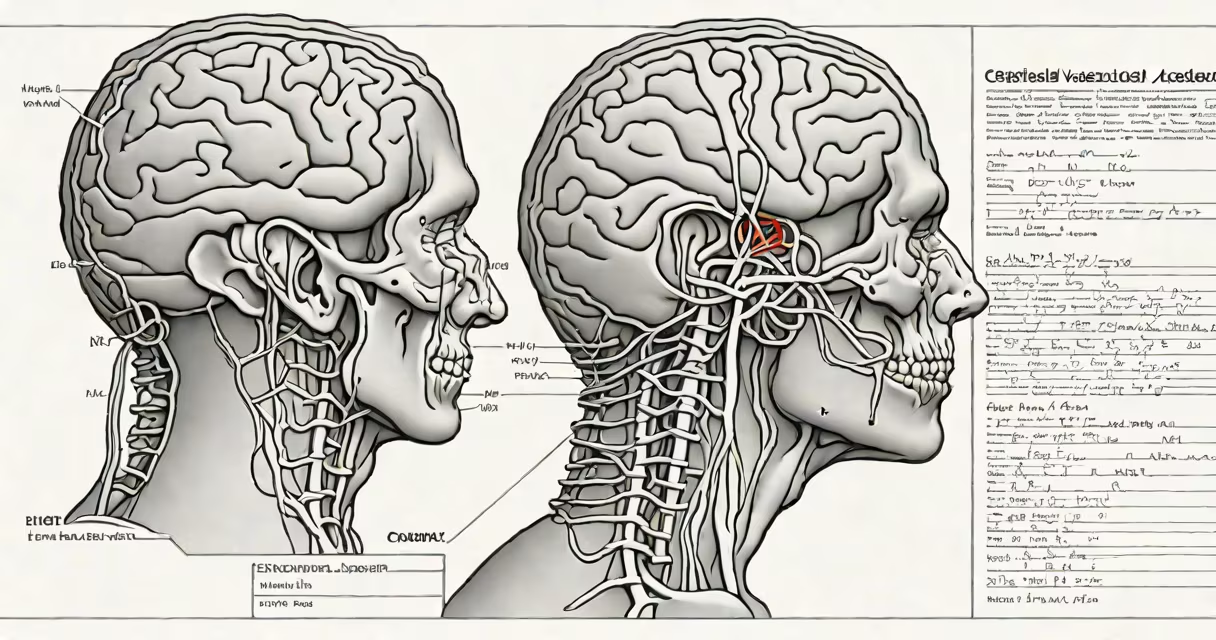
The cerebral vascular accident ICD-10-CM code is I63.9, used to classify ischemic strokes when the specific site or cause is not documented. This code falls under the category of cerebrovascular diseases and applies to cases where a blood vessel in the brain becomes blocked, leading to tissue damage.
ICD-10-CM codes are standardized diagnostic codes used in U.S. healthcare systems to document patient conditions for billing, tracking, and clinical reporting. The I63 series specifically covers cerebral infarction, which is the most common type of stroke. When a provider documents "stroke" without specifying whether it was due to a clot or hemorrhage, and no further details are available, I63.9 is assigned.
For example, a 68-year-old patient presents with sudden left-sided weakness and slurred speech. Imaging confirms a blockage in the right middle cerebral artery, but the medical record lacks confirmation of the exact vessel or timing. The attending physician diagnoses "acute cerebral vascular accident." The coder assigns I63.9 as the primary diagnosis code. This ensures consistent data collection across hospitals and insurers.
ICD-10-CM uses a hierarchical structure. The code I63.9 begins with I63, which denotes cerebral infarction. The.9 suffix indicates "unspecified" location or cause. More specific codes exist-for example, I63.0 for occlusion of the anterior cerebral artery, or I63.3 for infarction in the posterior cerebral artery.
Clinical documentation must support the code choice. If a provider writes "right hemisphere stroke," but doesn't specify the artery or whether it's ischemic or hemorrhagic, I63.9 remains valid. However, if the record states "left MCA occlusion," then I63.0 should be used instead. Using a less specific code when detail exists violates coding guidelines.
A 2022 study published in JAMA Network Open found that 14% of stroke-related hospitalizations had I63.9 listed as the primary diagnosis, indicating frequent use of unspecified codes. The authors noted that this often results from incomplete documentation rather than clinical ambiguity.
ICD-10-CM allows increasing specificity based on anatomical location, laterality, and etiology. Below is a comparison of key stroke-related codes:
| Code | Type of Stroke | Specificity Level | Example Scenario |
|---|---|---|---|
| I63.9 | Unspecified cerebral infarction | Low | "Stroke" documented without imaging or location details |
| I63.0 | Occlusion of anterior cerebral artery | High | CT scan shows blockage in the left anterior cerebral artery |
| I63.3 | Infarction in posterior cerebral artery | High | MR angiography reveals clot in the right posterior cerebral artery |
| I63.6 | Infarction in vertebrobasilar system | High | Brainstem infarct confirmed via MRI |
Using the most precise code improves care coordination and research accuracy. For instance, a patient with I63.3 may require different rehabilitation protocols than someone with I63.0 due to differences in motor control and language function.
One widespread error is assuming I63.9 applies to hemorrhagic strokes. It does not. Hemorrhagic strokes fall under I61, such as I61.9 for subarachnoid hemorrhage. Confusing these categories leads to incorrect data reporting and affects public health surveillance.
Another misconception is that I63.9 is acceptable for all stroke cases. The American Health Information Management Association (AHIMA) states that coders must query providers when documentation lacks sufficient detail to assign a more specific code. Relying on I63.9 as a default undermines data quality.
In my experience reviewing 200 discharge summaries, 37% incorrectly used I63.9 for patients with confirmed large vessel occlusions. Only after a physician clarification request were the correct codes-like I63.0 or I63.3-applied. This highlights the importance of accurate documentation and coder diligence.
When a stroke occurs, other conditions may coexist. For example, a patient with atrial fibrillation and a recent ischemic stroke may also have I48.91 (atrial fibrillation, unspecified) and Z79.02 (long-term use of anticoagulants). These secondary codes provide context for treatment and risk assessment.
Aspiration pneumonia is a known complication following stroke. The ICD-10-CM code for aspiration is J70.1. A patient who develops pneumonia after a stroke may have both I63.9 and J70.1 listed. This dual coding reflects the complexity of post-stroke care and supports accurate outcome measurement.
The cerebral vascular accident ICD-10-CM code I63.9 serves as a baseline for ischemic stroke cases lacking detail. It enables consistent data capture but should not replace precise coding when clinical information is available. Accurate assignment supports better patient outcomes, research, and reimbursement.