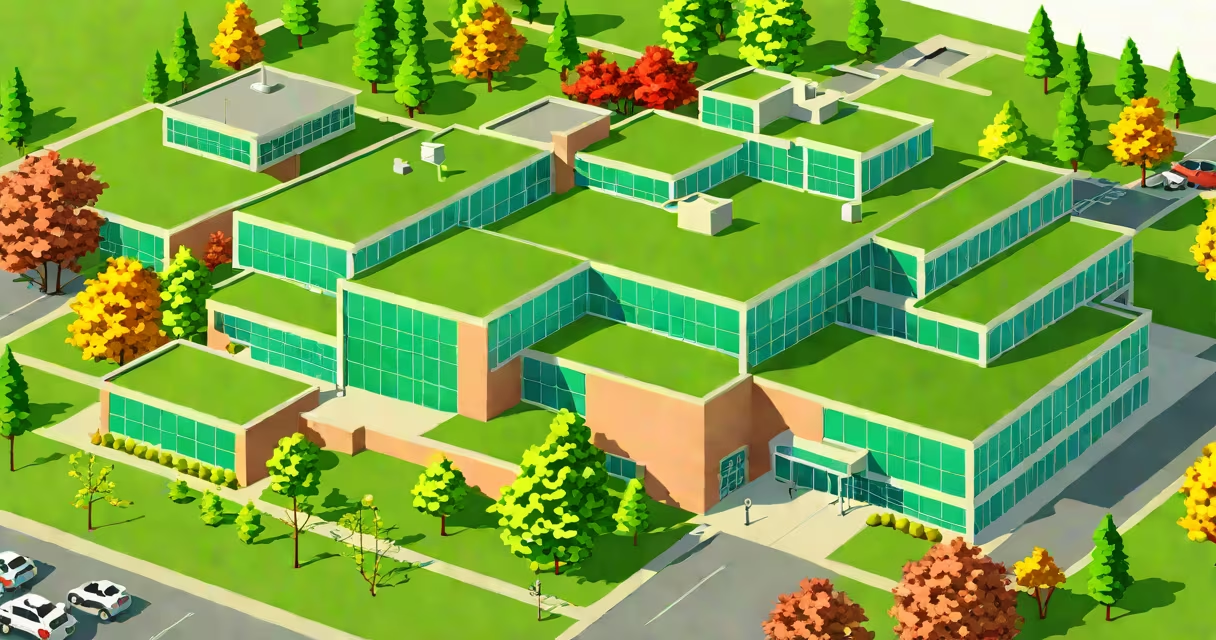
Burnaby Mountain Secondary School is a public high school located in Burnaby, British Columbia, serving students in grades 8 through 12. It operates under the jurisdiction of School District 41 (Burnaby), offering a curriculum aligned with the British Columbia Ministry of Education standards.
The school sits on a hillside overlooking the city, with views extending toward the Coast Mountains. Its campus includes science labs, visual arts studios, a performing arts theatre, and a gymnasium. Students take part in core subjects such as math, English, social studies, and sciences, along with elective courses in technology, music, and physical education.
Burnaby Mountain Secondary School emphasizes academic achievement, student leadership, and community engagement. It offers Advanced Placement (AP) courses in select disciplines, including AP Calculus AB and AP Psychology. The school's graduation rate exceeds 94%, according to district reports from 2022-2023.
Students attend classes in 75-minute blocks, following a semestered timetable. Each year, they complete four core courses and two electives. Credit accumulation follows the BC Ministry's credit system: one course equals one credit, and students need 80 credits to graduate.
Academic tracking begins in Grade 9. Students are placed in level-appropriate math and English courses based on prior performance and diagnostic assessments. For example, a student scoring in the 80th percentile on a provincial reading benchmark may be assigned to English 10 Academic rather than Applied.
Class sizes average 25 students. Teachers use a mix of direct instruction, collaborative learning, and project-based assignments. A typical Grade 10 biology class might spend two weeks studying photosynthesis through lab experiments using spinach leaves and light intensity sensors.
Burnaby Mountain Secondary School offers several distinct academic pathways:
| Program Type | Eligibility | Key Features |
|---|---|---|
| Regular Academic | All students | Standard curriculum; prepares for university, college, or trades |
| Advanced Placement (AP) | Grade 10-12; GPA ≥ 3.0 | College-level courses; exams can earn university credit |
| International Baccalaureate (IB) Diploma Program | Grade 11-12; application required | Interdisciplinary, research-heavy; requires extended essay and CAS hours |
| Specialist High Skills Major (SHSM) | Grades 11-12; career-focused | Concentrates on sectors like health, business, or transportation |
The IB program at Burnaby Mountain is one of only five in the Lower Mainland approved by the International Baccalaureate Organization. Students in this track complete 150 hours of community service and submit a 4,000-word research paper.
Some parents assume Burnaby Mountain Secondary School is selective. It is not. Admission is based on residential zoning within School District 41 boundaries. Families living outside the zone may apply for transfer, but acceptance is not guaranteed.
Another misconception is that the school lacks arts programming. In reality, it hosts an annual spring musical, a student-run film festival, and a biannual art show. In 2023, the school's drama troupe performed *The Crucible* at the Vancouver Fringe Festival, earning a nomination for Best Ensemble.
A less obvious point: the school does not offer French Immersion. While many nearby schools do, Burnaby Mountain Secondary provides French as a second language (FSL) in Grades 8-12. Students can earn a French Language Proficiency Certificate upon completing four FSL credits and passing a DELF exam.
In 2022, Maya Chen, a Grade 10 student, enrolled in the AP Psychology course. She had scored in the 90th percentile on her Grade 9 Social Studies final. Her teacher recommended her based on consistent participation and written analysis skills.
Over the year, Maya completed weekly readings from *Psychology* by David Myers, wrote six short essays analyzing cognitive biases, and conducted a study on sleep deprivation's effect on memory in 20 peers. She scored a 4 on the AP exam, qualifying for three university credits at UBC.
Her experience reflects the school's commitment to evidence-based learning. According to a 2023 report by the BC Ministry of Education, 68% of Burnaby Mountain students who took AP exams scored a 3 or higher, above the provincial average of 59%.
I visited Burnaby Mountain Secondary School during a parent-teacher night in November 2023. The library was filled with students working on group projects. A Grade 11 physics class presented a model of a solar-powered car they'd built using recycled materials. The presentation included a 120-second pitch, a prototype demonstration, and a cost-benefit analysis.
Teachers were present but not directing. Students explained their design choices, challenges, and improvements. One student noted, "We failed twice before we got the motor to turn." The room buzzed with focused energy-no distractions, no off-task behavior.
Burnaby Mountain Secondary School serves approximately 1,250 students annually. Most come from neighborhoods like Brentwood, Edmonds, and North Burnaby. The school's location near transit routes makes it accessible to families without cars.
It is used as a hub for community programs. The school partners with local organizations to run after-school tutoring, mental health workshops, and youth leadership training. In 2023, it hosted a climate action summit attended by 200 students from 12 schools across Metro Vancouver.
Its role extends beyond academics. The school's wellness center offers free counseling services, and the student-led peer support network runs weekly check-ins. These initiatives align with the BC Ministry's Mental Health and Wellbeing Structure, which mandates that all public schools provide access to psychological resources.