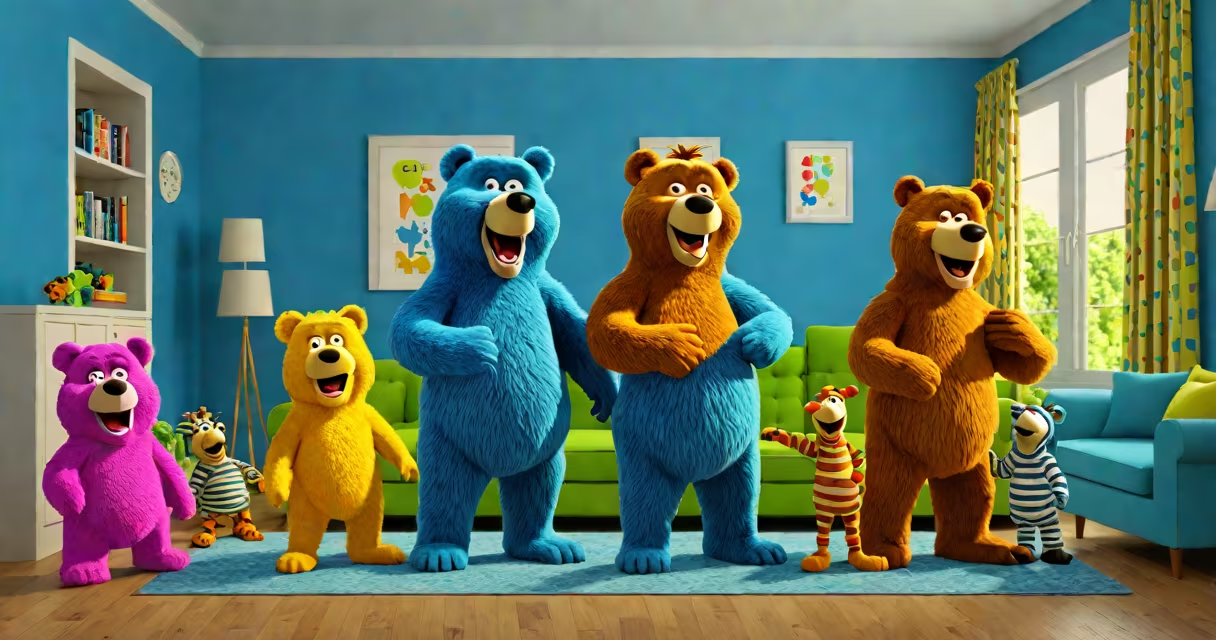
The bear in the big blue house characters are the main figures in the PBS Kids animated series Bear in the Big Blue House, where Big Bear, Little Bear, and their animal friends live in a whimsical home filled with puzzles, music, and problem-solving. The show aired from 2002 to 2006 and was designed for preschoolers aged 3 to 5.
Big Bear is the largest and most responsible character. He wears a red sweater and blue pants, speaks slowly and, and often takes charge during group activities. His calm demeanor and gentle guidance make him a steady presence. When a problem arises-like a missing sock or a broken toy-he leads the others through logical steps to find a solution. He frequently uses phrases like "Let's think about this" and "I have a plan."
Little Bear is smaller, energetic, and curious. He wears green pants and a yellow shirt. He often asks questions, gets excited about new ideas, and sometimes acts impulsively. His enthusiasm drives many of the show's adventures. He's prone to misplacing things-like his favorite hat or a game piece-but always learns from the mistake. His catchphrase, "I'm little, but I'm smart!" reflects his growing confidence.
| Character | Appearance | Personality Trait | Role in Episodes |
|---|---|---|---|
| Big Bear | Large, brown bear, red sweater, blue pants | Thoughtful, patient, leader | Problem solver, decision-maker |
| Little Bear | Small, brown bear, green pants, yellow shirt | Curious, enthusiastic, impulsive | Questioner, idea generator |
| Mr. Peabody | Blue bird, glasses, bow tie | Wise, formal, knowledgeable | Guide, teacher, narrator |
| Miss Prissy | Pink rabbit, long ears, floral dress | Polite, organized, detail-oriented | Planner, rule-follower |
Mr. Peabody is a blue bird who lives in the house and serves as the intellectual anchor. He wears glasses, a bow tie, and a white lab coat. He often explains concepts using songs or rhymes. His dialogue is precise and educational, reflecting a focus on early literacy and emotional regulation. For example, he teaches children how to manage frustration by saying, "When we feel angry, we can take three deep breaths."
Miss Prissy is a pink rabbit who values neatness and order. She wears a floral dress and keeps the house tidy. Her role is to model routines and social expectations. She often reminds the bears to clean up after playtime or to greet visitors properly. Her calm voice contrasts with Little Bear's bursts of energy, creating balance in the group dynamics.
A common misconception is that the characters are purely comedic. While the show includes humor, especially in the exaggerated reactions of Little Bear, its core purpose is developmental education. According to the PBS Kids official site, the series was developed with input from child psychologists and early childhood educators. It emphasizes emotional intelligence, cooperation, and cause-and-effect reasoning.
One non-obvious fact: the show avoids conflict resolution through punishment. Instead, characters learn to reflect on their actions and apologize. In episode 12, "The Missing Sock," Little Bear loses his favorite sock. He initially blames Big Bear, but after talking it out, he admits he forgot where he left it. Big Bear responds, "That's okay. We'll look together." This mirrors evidence-based practices in preschool behavior management, as cited by the National Association for the Education of Young Children (NAEYC).
Another key feature is the integration of music. Each episode ends with a song that summarizes the lesson. In "Sharing Is Caring," the characters sing, "We share our toys, we share our space, we share our time with everyone." These songs reinforce vocabulary and social norms through repetition and melody.
I once watched an episode with my nephew, who was three at the time. He paused the video when Little Bear dropped his spoon and asked, "Why did he do that?" I explained that the show shows mistakes happen, but people can fix them. He then mimicked Big Bear's calm voice and said, "Let's think about this." That moment confirmed the show's impact: it models emotional regulation in real time.
While the original series ended in 2006, reruns continue on PBS Kids platforms. The characters remain popular in educational settings. Teachers use clips to teach sharing, listening, and turn-taking. The show's structure-problem, discussion, solution-mirrors the inquiry-based learning model recommended by NAEYC.
The bear in the big blue house characters are not just animated figures-they are tools for early development. Their consistent personalities, structured interactions, and emphasis on emotional learning make them effective educators in a screen format.