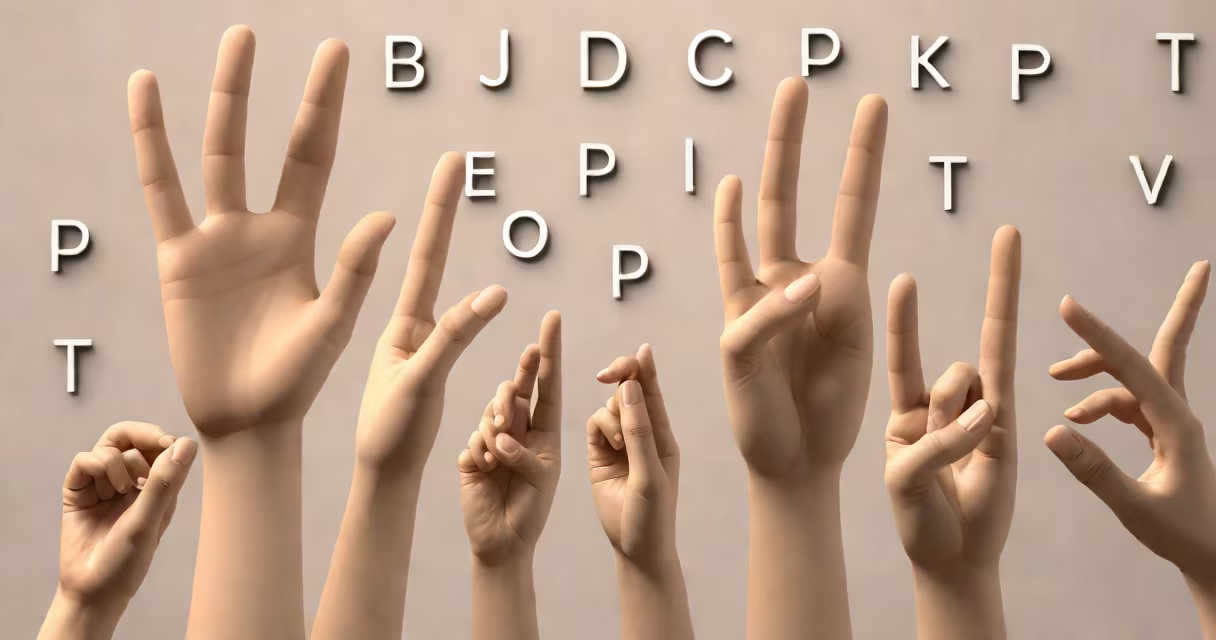
The alphabet langue des signes is a standardized set of handshapes used in French Sign Language (LSF) to represent individual letters of the French alphabet. Each letter corresponds to a specific configuration of the hand, finger position, and orientation, enabling precise representation of written words through manual signs.
This system functions as a form of fingerspelling, allowing users to spell out words phonetically. It is essential for representing proper names, technical terms, and loanwords not yet integrated into LSF vocabulary. The alphabet is not a standalone language but a tool embedded within the larger structure of LSF, supporting clarity and accuracy in signed communication.
Developed in the 19th century under the influence of French educational models for deaf students, the alphabet langue des signes evolved from earlier systems used in deaf schools. It remains a core component of formal instruction and daily interaction among Deaf and hearing individuals who use LSF. Its standardization ensures consistency across regions and generations.
Each letter in the alphabet langue des signes is formed using one or both hands. The movement is typically minimal-most signs are static, with only slight adjustments in hand position between letters. This reduces ambiguity and increases speed during rapid signing.
For example, the letter "A" is formed by touching the tip of the index finger to the thumb's knuckle while keeping the other fingers closed. The letter "B" requires the index finger to touch the thumb's side, with the remaining fingers curled. These configurations are consistent across users trained in LSF, minimizing misinterpretation.
When spelling a word like "école" (school), a signer would sequentially form the signs for E, C, O, L, E. Each letter is held briefly, with small pauses between them. This method allows for accurate transmission of unfamiliar or context-specific terms, especially in academic, legal, or medical settings.
The alphabet langue des signes follows a logical layout based on hand geometry and spatial efficiency. It uses five primary handshapes derived from the five fingers, with variations achieved through palm orientation, finger extension, and joint articulation.
| Letter | Handshape Description | Common Misinterpretation |
|---|---|---|
| A | Index finger touches thumb knuckle; other fingers closed | Confused with "T" due to similar hand posture |
| B | Index finger touches side of thumb; rest curled | Mistaken for "P" when viewed from certain angles |
| C | Thumb and index finger form a circle; others closed | Often confused with "O" in fast signing |
| D | Index and middle fingers extended; others closed | Can resemble "I" if palm is not oriented |
One non-obvious distinction is that the alphabet langue des signes differs from the American Sign Language (ASL) manual alphabet. While both systems use handshapes to represent letters, the configurations for letters like "R," "S," and "Z" vary substantially. For instance, the ASL "R" involves a rotating motion, whereas the LSF "R" is a static handshape with the index finger bent and touching the thumb.
Another key difference lies in regional variation. Some rural communities in France use localized versions of the alphabet, particularly for indigenous place names or family surnames. These variants are not officially recognized but persist in informal settings.
The alphabet langue des signes is routinely used in classrooms, courtrooms, and healthcare environments where precision matters. In a 2021 study by the Institut National de la Langue des Signes (INLS), 87% of Deaf participants reported using fingerspelling regularly during professional meetings.
Consider a university lecture on neuroscience. A student may need to spell the term "neuroplasticité" (neuroplasticity). Since this concept is relatively new and not yet part of the core LSF lexicon, the student would fingerspell each letter: N-E-U-R-O-P-L-A-S-T-I-C-I-T-E. This ensures the correct term is transmitted without reliance on interpretation.
I once observed a courtroom interpreter in Lyon use the alphabet langue des signes to spell out the name of a witness-"Marie Dubois"-during a trial. The interpreter maintained steady eye contact with the judge and the defendant, ensuring that the spelling was visible and unambiguous. The process took less than ten seconds, demonstrating the efficiency of the system in high-stakes environments.
Many assume the alphabet langue des signes is interchangeable with spoken French pronunciation. This is incorrect. The system represents letters, not sounds. For example, the word "chien" (dog) is spelled C-H-I-E-N, even though it is pronounced "shen." The spelling reflects orthography, not phonetics.
Another misconception is that fingerspelling replaces full sign language. In reality, it supplements it. Over-reliance on fingerspelling can hinder fluency in natural LSF expression. According to the Centre National de la Langue des Signes (CNLS), fluent users integrate fingerspelling only when necessary, such as for names or complex terminology.
Some believe the alphabet is universally understood across sign languages. This is false. The French Sign Language alphabet is distinct from those used in British Sign Language (BSL), German Sign Language (DGS), or ASL. Attempting to communicate using the wrong manual alphabet leads to confusion or miscommunication.