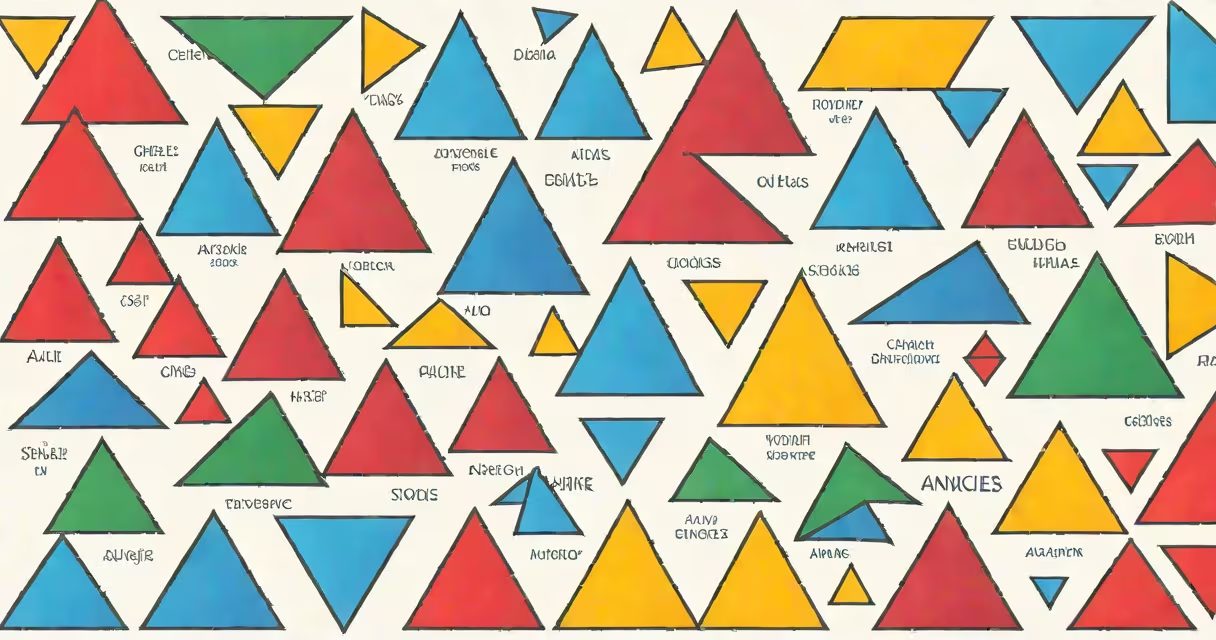
All types of triangles are geometric figures with three sides and three angles, classified by their side lengths (scalene, isosceles, equilateral) or internal angles (acute, right, obtuse). These categories define shape properties and practical applications in architecture, engineering, and design.
Triangles fall into two primary classification systems: by side lengths and by internal angles. The side-based system identifies whether sides are equal or unequal. The angle-based system sorts them based on whether all angles are less than 90°, exactly 90°, or greater than 90°.
Each classification has strict mathematical definitions. For example, a triangle with three equal sides must have three equal angles-each measuring exactly 60°. This is known as an equilateral triangle. A triangle with two equal sides is isosceles. If all sides differ, it's scalene.
Angles determine another set of types. An acute triangle has all angles under 90°. A right triangle contains one 90° angle. An obtuse triangle includes one angle exceeding 90°. No triangle can have more than one right or obtuse angle because the sum of interior angles must always be 180°.
Side-length classification divides triangles into three forms:
| Type | Sides | Angles | Example Use |
|---|---|---|---|
| Scalene | All different lengths | All different angles | Roof trusses in uneven terrain |
| Isosceles | Two equal sides | Two equal angles | Design of symmetrical logos |
| Equilateral | All three sides equal | All three angles 60° | Tile patterns in mosaics |
A scalene triangle has no symmetry. Its angles vary widely-such as 40°, 60°, and 80°-and it cannot be folded onto itself along any axis. Isosceles triangles have one line of symmetry through the vertex between the two equal sides. Equilateral triangles have three lines of symmetry and rotational symmetry of 120°.
For example, a triangle with side lengths 5 cm, 7 cm, and 9 cm is scalene. A triangle with sides 6 cm, 6 cm, and 8 cm is isosceles. One with sides 4 cm, 4 cm, and 4 cm is equilateral. Each type follows the triangle inequality theorem: the sum of any two sides must exceed the third.
Angle-based classification defines three types:
Right triangles follow the Pythagorean theorem: a² + b² = c², where c is the hypotenuse-the longest side opposite the right angle. This principle enables precise distance calculations in surveying and navigation.
A common mistake is assuming that a triangle with a 90° angle must be isosceles. That's false. A right triangle can be scalene (e.g., 3-4-5 triangle) or isosceles (e.g., 45°-45°-90° triangle). The 45-45-90 triangle appears frequently in construction and art due to its symmetry and ease of measurement.
Many assume that all equilateral triangles are right triangles. This is incorrect. An equilateral triangle has three 60° angles-none reach 90°. The sum of angles in any triangle is always 180°, so a triangle cannot contain both a 90° angle and three equal angles.
Another error is believing that a triangle with two equal angles must have two equal sides. This is true-but only because of the converse of the base angles theorem in Euclidean geometry. Equal angles imply equal opposite sides. This relationship is foundational in proof-based geometry.
One non-obvious fact: in spherical geometry, a triangle can have three 90° angles. On a globe, connecting the North Pole to two points on the equator creates a triangle with three right angles. This doesn't apply in flat (Euclidean) space, where such a triangle is impossible.
Architects use right triangles to ensure structural stability. The 3-4-5 rule-a right triangle with sides 3, 4, and 5 units-is a standard method for checking square corners during framing. Builders verify alignment by measuring diagonals: if both match, the corner is square.
In nature, triangular shapes appear in crystals. Quartz forms hexagonal prisms with triangular cross-sections. The arrangement of atoms in a tetrahedral molecule, like methane (CH₄), results in four triangular faces around a central carbon atom.
I once measured a sloped roof using a right triangle. The horizontal run was 12 feet, the vertical rise was 5 feet. Using the Pythagorean theorem, the rafter length was √(12² + 5²) = √(144 + 25) = √169 = 13 feet. This calculation ensured accurate material ordering.
All types of triangles are defined by side length and angle measures. They include scalene, isosceles, and equilateral based on sides; acute, right, and obtuse based on angles. Understanding these categories enables accurate design, measurement, and problem-solving across disciplines. Recognizing the difference between angle-based and side-based classification prevents errors in geometry and applied math.