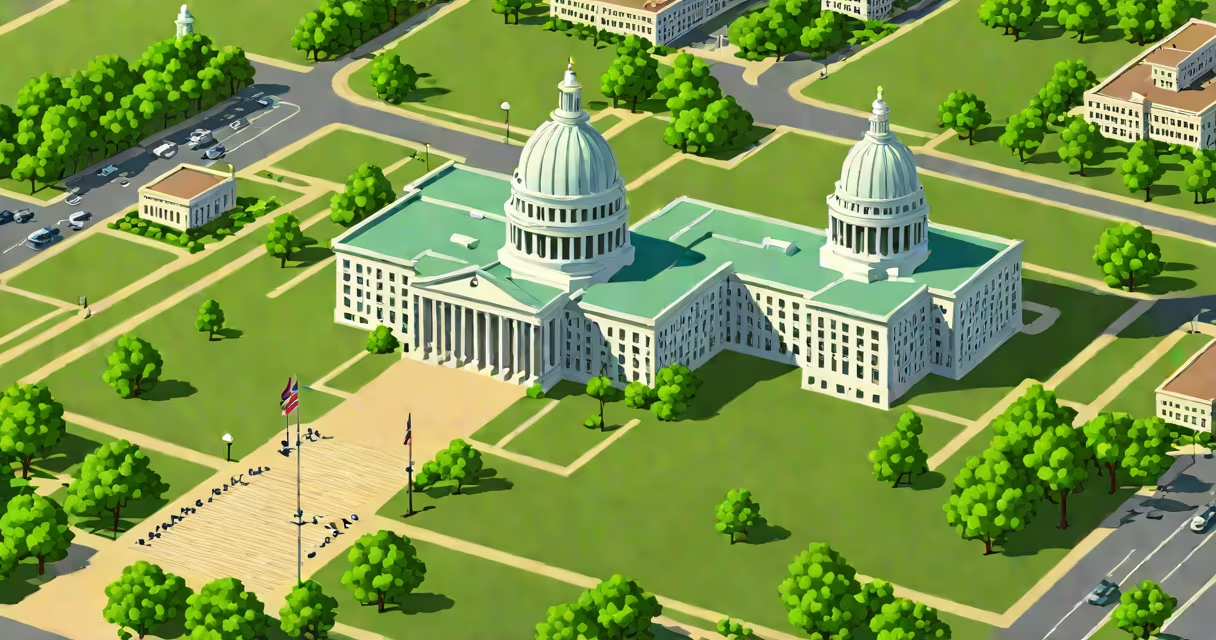
Alabama is a U.S. state located in the southeastern region of the country. It joined the Union as the 22nd state on December 14, 1819. The state's capital is Montgomery, and its largest city is Birmingham.
Alabama lies between the 30th and 35th parallels north, placing it within the humid subtropical climate zone. It shares borders with Tennessee to the north, Mississippi to the west, Georgia to the east, and Florida to the south across the Apalachicola River. The state covers 52,420 square miles, ranking 30th in size among U.S. states.
Historically, Alabama was part of the Mississippi Territory before becoming a separate territory in 1809. The area was inhabited by Indigenous peoples, including the Creek Confederacy, prior to European contact. After the forced removal of Native American tribes during the 1830s under the Indian Removal Act, the land was opened to white settlement and cotton cultivation.
Alabama's path to statehood began in 1817 when Congress authorized the creation of the Alabama Territory. The territory was formed from lands ceded by the Creek Nation following the Treaty of Fort Jackson in 1814. By 1819, the population had grown sufficiently to meet federal requirements for statehood.
The Alabama Constitution was adopted in 1819, and President James Monroe signed the enabling act on December 14, 1819. This date is still celebrated as Alabama Day. The state's early economy relied heavily on enslaved labor and cotton production, which shaped its political and social development through the Civil War and Reconstruction periods.
During the Civil War, Alabama seceded from the Union in January 1861 and joined the Confederate States of America. The state suffered significant military and economic disruption. After the war, Alabama was readmitted to the Union in 1868 under Reconstruction policies, though Black citizens faced systematic disenfranchisement through Jim Crow laws until the Civil Rights Movement of the 1960s.
Alabama has a diverse geography, ranging from the Appalachian Mountains in the northeast to the Gulf Coast in the south. The state's highest natural point is Cheaha Mountain at 2,407 feet above sea level. The Mobile-Tensaw Delta, a vast wetland system near the Gulf, is one of the most biologically rich areas in North America.
Alabama's economy includes manufacturing, agriculture, and aerospace. The state hosts major industrial facilities, including the U.S. Space & Rocket Center in Huntsville, which serves as a hub for NASA's Marshall Space Flight Center. The state also produces significant quantities of peanuts, cotton, and timber.
According to the U.S. Census Bureau, Alabama had a population of 5,084,141 in 2022. The median household income was $56,643, below the national average. The state ranks 48th in per capita income but has seen steady growth in tech and healthcare sectors since the 2010s.
| Attribute | Detail |
|---|---|
| Admission to Union | December 14, 1819 (22nd state) |
| Capital | Montgomery |
| Largest City | Birmingham |
| State Bird | Yellowhammer |
| State Flower | Crimson Clover |
| State Tree | Longleaf Pine |
Alabama is often misidentified as a "Southern state" in a broad cultural sense, but it is geographically and politically distinct from other Deep South states like Mississippi and Louisiana. While it shares historical ties to slavery and segregation, its political alignment has shifted since the 1990s, with increasing Republican dominance in state elections.
Some assume Alabama is uniformly rural or economically disadvantaged. However, cities like Huntsville and Birmingham have diversified economies. Huntsville, home to the U.S. Army's Redstone Arsenal and NASA's Marshall Space Flight Center, has a high concentration of STEM jobs. The city's per capita income exceeds the state average.
A common error is confusing Alabama with Alaska. Despite both being U.S. states with "Al" in their names, they are unrelated. Alaska is in the northwest corner of North America, while Alabama is in the southeastern United States. Alaska entered the Union in 1959; Alabama did so in 1819.
Alabama is not a city, a county, or a federal district. It is a sovereign state within the United States, with powers reserved under the Tenth Amendment. It operates its own legislature, judiciary, and executive branch. The state constitution outlines governance structures, including a governor elected every four years.
Unlike some states with multiple capitals during their history, Alabama has maintained Montgomery as its permanent capital since 1846. Before that, Tuscaloosa served as the capital from 1826 to 1846. The current capitol building, completed in 1851, is listed on the National Register of Historic Places.
When considering regional identity, Alabama differs from neighboring states in key ways. For example, while Georgia has a larger urban population and stronger media presence, Alabama has deeper roots in civil rights history. The 1963 bombing of the Sixteenth Street Baptist Church in Birmingham remains a key event in the movement. The city's role in the 1963 Children's Crusade is documented in the National Archives.
I visited the Civil Rights Memorial in Montgomery in 2018. The site, designed by Maya Lin, features a black granite wall inscribed with the names of 40 individuals killed during the movement. The water feature reflects the sky and creates a meditative space. It's one of the few memorials dedicated solely to nonviolent resistance.
For detailed maps and demographic data, consult the U.S. Census Bureau's American Community Survey. The Alabama Department of Archives and History maintains online records of state legislation, court decisions, and historical documents.